
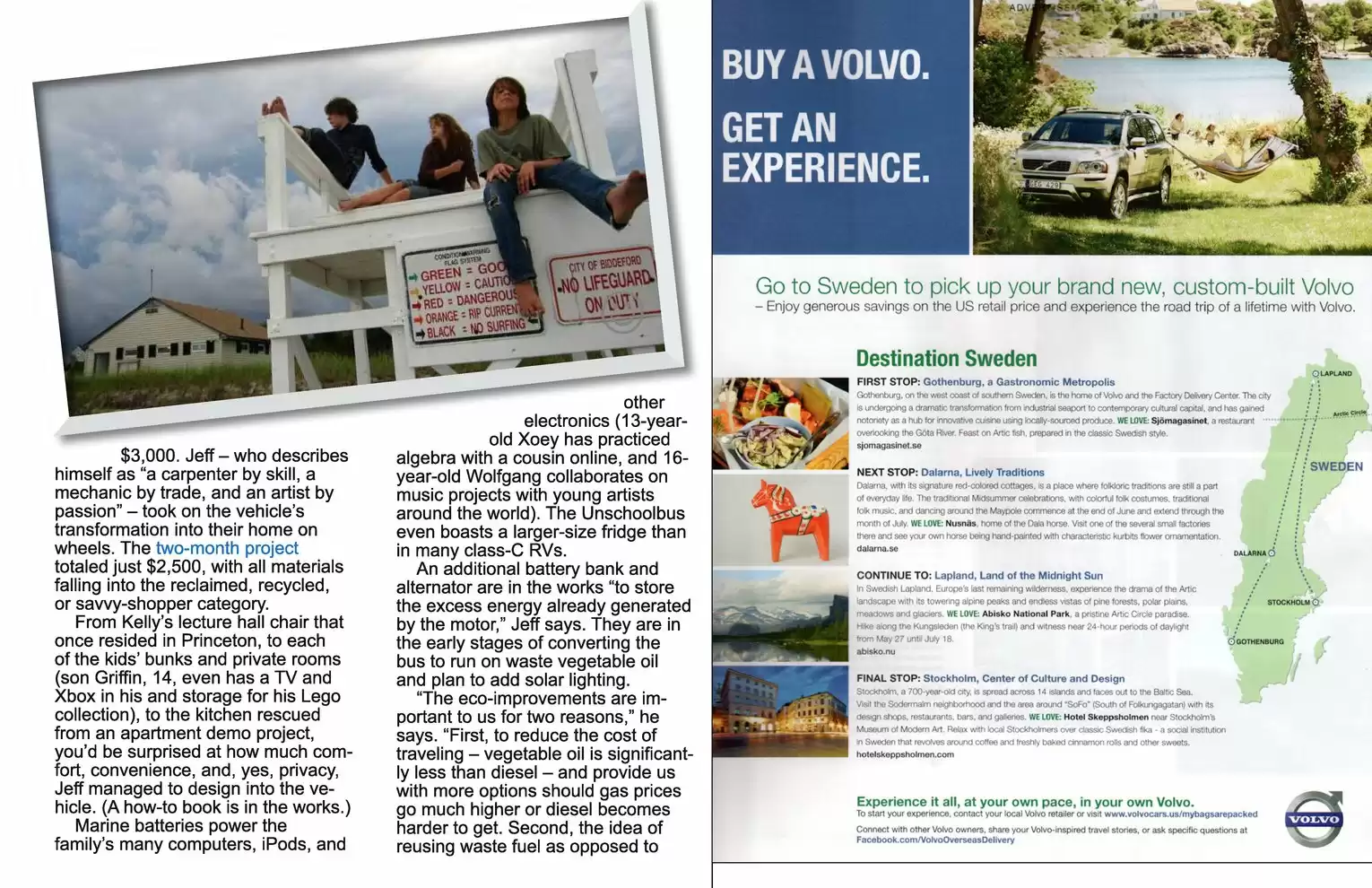
From Kelly's lecture hall chair that once resided in Princeton, to each of the kids' bunks and private rooms (son Griffin, 14, even has a TV and Xbox in his and storage for his Lego collection), to the kitchen rescued from an apartment demo project, you'd be surprised at how much comfort, convenience, and, yes, privacy, Jeff managed to design into the vehicle. (A how-to book is in the works.)
Marine batteries power the family's many computers, iPods, and other electronics (13-year-old Xoey has practiced algebra with a cousin online, and 16-year-old Wolfgang collaborates on music projects with young artists around the world). The Unschoolbus even boasts a larger-size fridge than in many class-C RVs.
An additional battery bank and alternator are in the works "to store the excess energy already generated by the motor," Jeff says. They are in the early stages of converting the bus to run on waste vegetable oil and plan to add solar lighting.
"The eco-improvements are important to us for two reasons," he says. "First, to reduce the cost of traveling--vegetable oil is significantly less than diesel--and provide us with more options should gas prices go much higher or diesel becomes harder to get. Second, the idea of reusing waste fuel as opposed to
| Previous Page | Next Page |
Contents
Features:
Departments:
- Contributors
- Behind the Wheel: 2011 Hyundai Genesis
- Behind the Wheel: 2011 Chrysler 200 Limited
- Not Found on eBay
- Travel and Book Reviews
- Travel News
- Auto News
- Cruising Round-Up