
The rear seats, upholstered to match those in front, feature dual backrests that fold down to provide additional luggage space.
The classic 380-m.m. Carrera RS wheel of 1973 is standard fitment on the Singer 911--complete with the "butterfly" horn push assembly and a delicate, leather-wrapped rim to complement the legendary steering feel.
The classic off-white-on-black background gauges contribute to the cabin's wonderful retro ambience. Five gauges display fuel and oil level, oil temperature and oil pressure, the tachometer, a speedometer recalibrated to 180 m.p.h., and a clock.
A completely restored version of the classic Blaupunkt Frankfurt AM/FM radio from the early 1970s is standard equipment, complimenting the bespoke appointments throughout the cabin. These radios are essential equipment in an early 911 interior and complement the dash like no other head unit.
They come complete with power amp and state-of-the-art speakers. An integrated iPhone/iPad interface for the head unit and a Sirius satellite radio tuner are both optional.
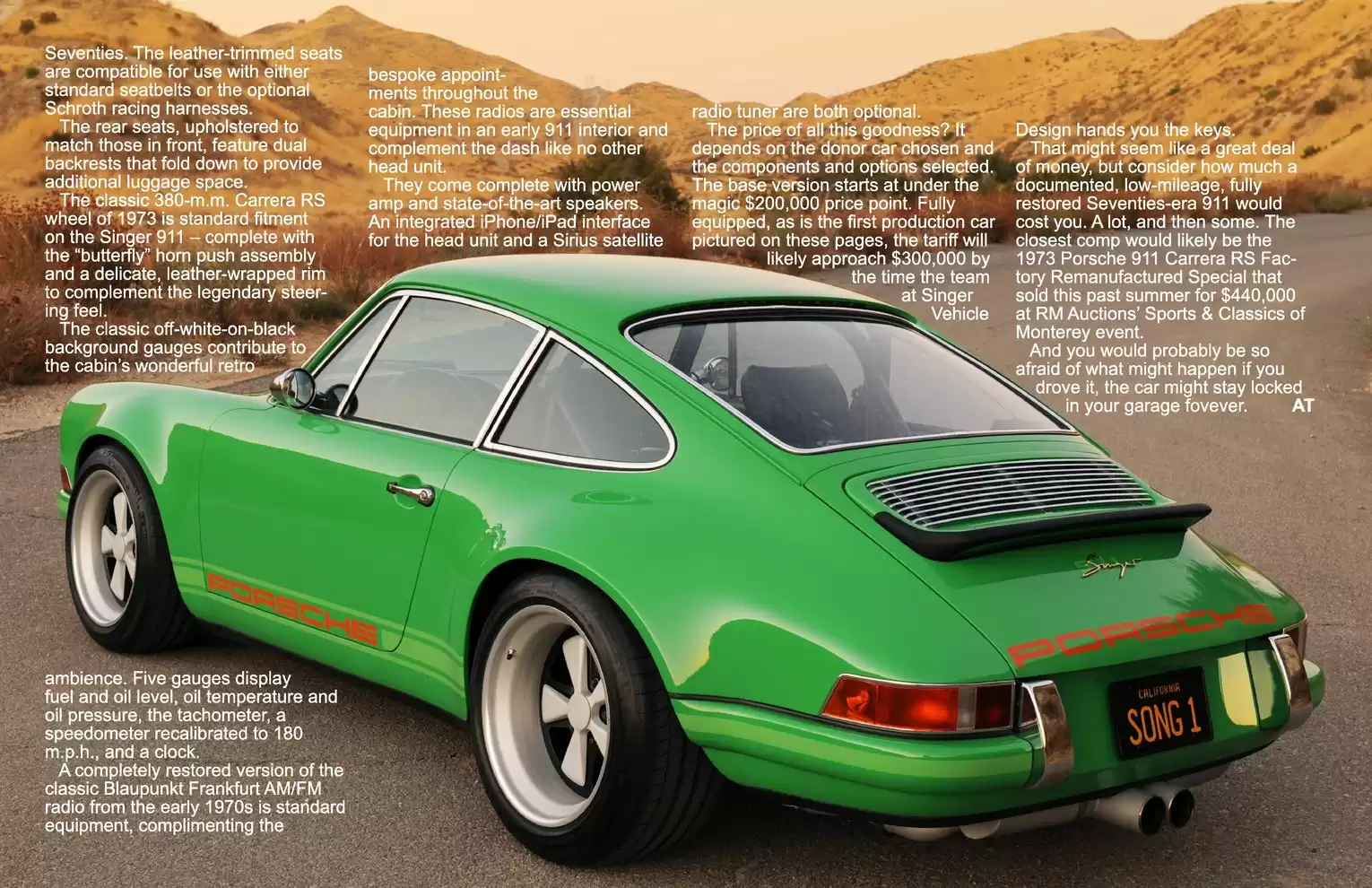
The price of all this goodness? It depends on the donor car chosen and the components and options selected. The base version starts at under the magic $200,000 price point. Fully equipped, as is the first production car pictured on these pages, the tariff will likely approach $300,000 by the time the team at Singer Vehicle Design hands you the keys.
That might seem like a great deal of money, but consider how much a documented, low-mileage, fully restored Seventies-era 911 would cost you. A lot, and then some. The closest comp would likely be the 1973 Porsche 911 Carrera RS Factory Remanufactured Special that sold this past summer for $440,000 at RM Auctions' Sports & Classics of Monterey event.
And you would probably be so afraid of what might happen if you drove it, the car might stay locked in your garage fovever.
| Previous Page | Next Page |
Contents
Features:
Departments:
- Contributors
- Behind the Wheel: 2011 Hyundai Genesis
- Behind the Wheel: 2011 Chrysler 200 Limited
- Not Found on eBay
- Travel and Book Reviews
- Travel News
- Auto News
- Cruising Round-Up