
Sales benefited from the car's success on the world's racetracks, as Aston Martin claimed the Sports Car World Championship while winning the 24 Hours of Le Mans for the second time.
Considering the car cost £3,967 (more than $7,000) at introduction, sales of the Aston Martin DB4 remained brisk during its production life. A total of 1,110 cars in all variants ran through 1963.
Depending on the gearing selected, the standard-spec DB4 was capable of a continent-crushing top speed of 150 miles per hour. It could accelerate to 60 miles per hour in 9.3 seconds--quick for its era --while delivering 15 miles per gallon.
Between the start of production until it was replaced in 1963 by the uprated DB5, the DB4 was available in five series.
The most visible changes were the addition of window frames in Series II and the adoption of a grille with vertical bars in Series IV, replacing the egg-crate grille of the earlier cars.
The final Series V cars, introduced in September 1962, featured a taller and longer body to provide more interior space. The front of the Series V cars was updated with more aerodynamic styling, a look incorporated by the DB5.
Noteworthy was the introduction of a convertible version of the Aston Martin DB4 in 1962. Styled in house but retaining the overall look of the coupe, 70 DB4 convertibles were built before production ended in 1963.
After the DB4 Zagato, those 70 vehicles (six fewer than the legendary DB4 GT) represented the rarest of all the David Brown-era Aston Martins. Brochures from the 1962-1963 period show the car adorned with an optional hardtop, quite rare for the period--and even rarer today among the cars that have survived.
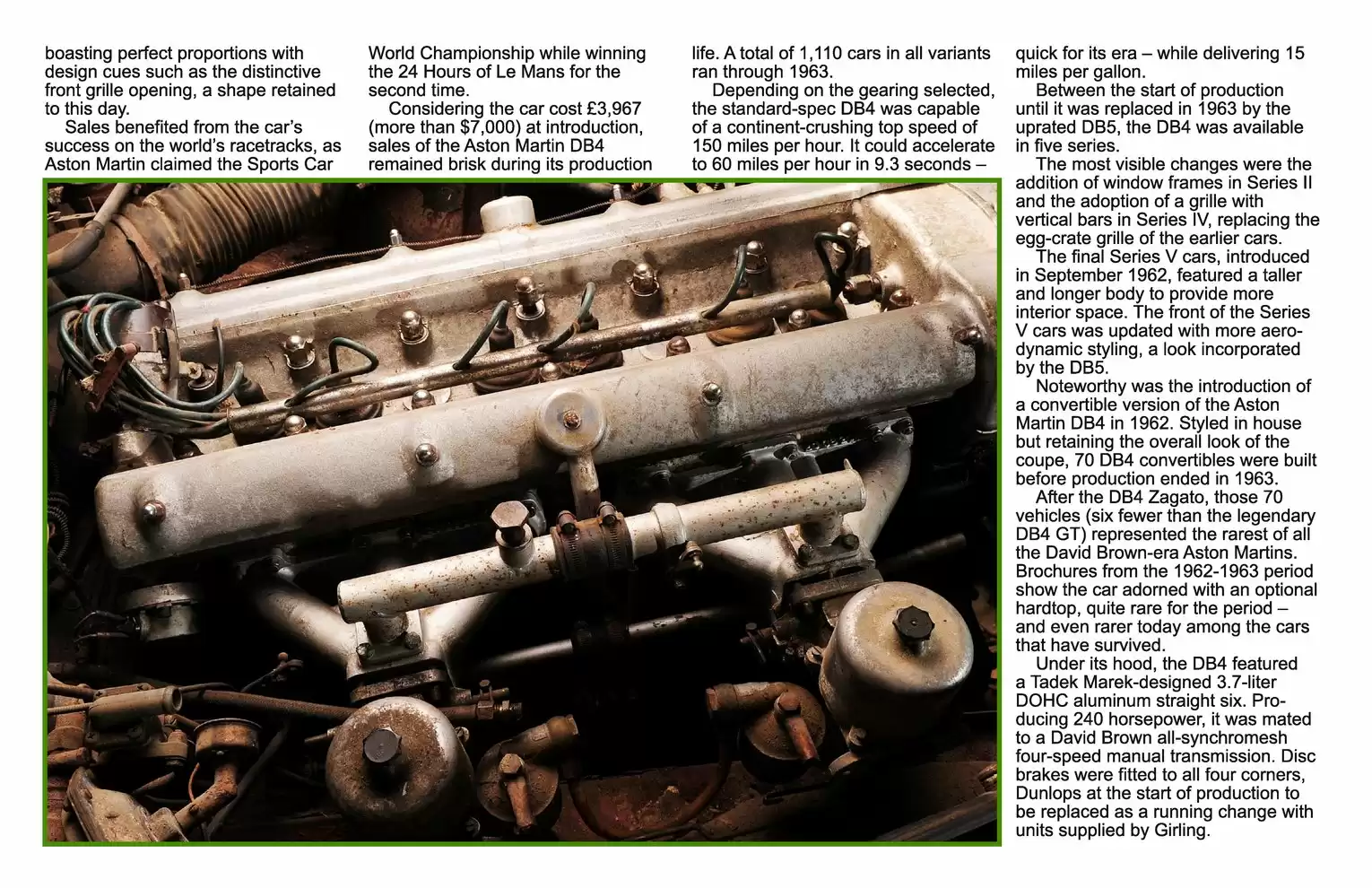
Under its hood, the DB4 featured a Tadek Marek-designed 3.7-liter DOHC aluminum straight six. Producing 240 horsepower, it was mated to a David Brown all-synchromesh four-speed manual transmission. Disc brakes were fitted to all four corners, Dunlops at the start of production to be replaced as a running change with units supplied by Girling.
| Previous Page | Next Page |
Contents
Features:
Departments:
- Contributors
- Behind the Wheel: 2011 Hyundai Genesis
- Behind the Wheel: 2011 Chrysler 200 Limited
- Not Found on eBay
- Travel and Book Reviews
- Travel News
- Auto News
- Cruising Round-Up