
work areas.
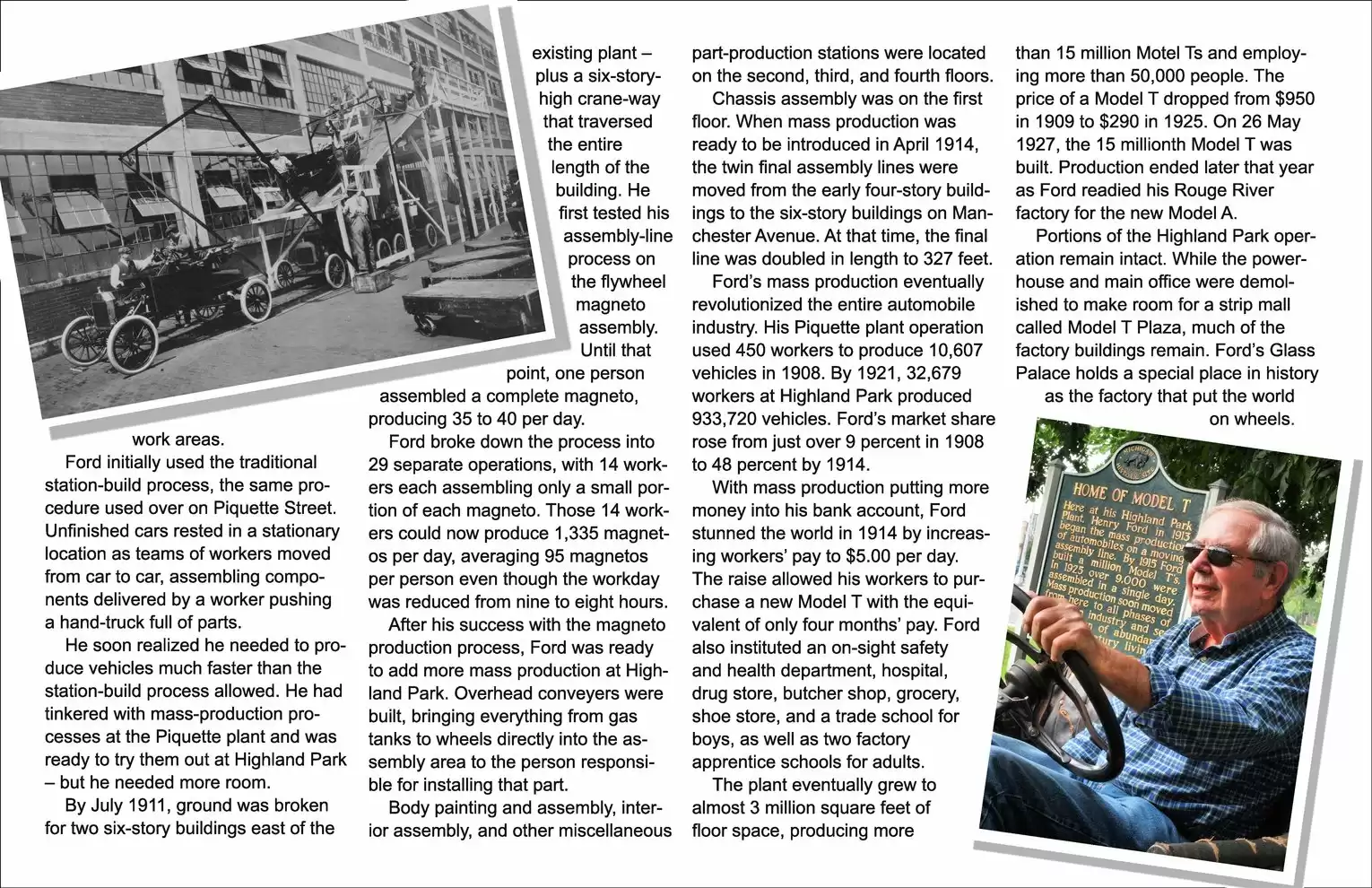
Ford initially used the traditional station-build process, the same procedure used on Piquette Street. Unfinished cars rested in a stationary location as teams of workers moved from car to car, assembling components delivered by a worker pushing a hand-truck full of parts. He soon realized he needed to produce vehicles much faster than the station-build process allowed. He had tinkered with mass-production processes at the Piquette plant and was ready to try them out at Highland Park--but he needed more room.
By July 1911, ground was broken for two six-story buildings east of the existing plant--plus a six-story-high crane-way that traversed the entire length of the building. He first tested his assembly-line process on the flywheel magneto assembly. Until that point, one person assembled a complete magneto, producing 35 to 40 per day. Ford broke down the process into 29 separate operations, with 14 workers each assembling only a small portion of each magneto. Those 14 workers could now produce 1,335 magnetos per day, averaging 95 magnetos per person even though the workday was reduced from nine to eight hours.
After his success with the magneto production process, Ford was ready to add more mass production at Highland Park. Overhead conveyers were built, bringing everything from gas tanks to wheels directly into the assembly area to the person responsible for installing that part. Body painting and assembly, interior assembly, and other miscellaneous part-production stations were located on the second, third, and fourth floors.
Chassis assembly was on the first floor. When mass production was ready to be introduced in April 1914, the twin final assembly lines were moved from the early four-story buildings to the six-story buildings on Manchester Avenue. At that time, the final line was doubled in length to 327 feet.
Ford's mass production eventually revolutionized the entire automobile industry. His Piquette plant operation used 450 workers to produce 10,607 vehicles in 1908. By 1921, 32,679 workers at Highland Park produced 933,720 vehicles. Ford's market share rose from just over 9 percent in 1908 to 48 percent by 1914.
With mass production putting more money into his bank account, Ford stunned the world in 1914 by increasing workers' pay to $5.00 per day. The raise allowed his workers to purchase a new Model T with the equivalent of only four months' pay. Ford also instituted an on-sight safety and health department, hospital, drug store, butcher shop, grocery, shoe store, and a trade school for boys, as well as two factory apprentice schools for adults.
The plant eventually grew to almost 3 million square feet of floor space, producing more than 15 million Motel Ts and employing more than 50,000 people. Thanks to plant efficiencies, the price of a Model T dropped from $950 in 1909 to $290 in 1925. On 26 May 1927, the 15 millionth Model T was built. Production ended later that year as Ford readied his Rouge River factory for the new Model A.
Portions of the Highland Park operation remain intact today. While the powerhouse and main office were demolished to make room for a strip mall called Model T Plaza, much of the original factory buildings remain. Ford's Glass Palace holds a special place in history as the factory that put the world on wheels.
| Previous Page | Next Page |