
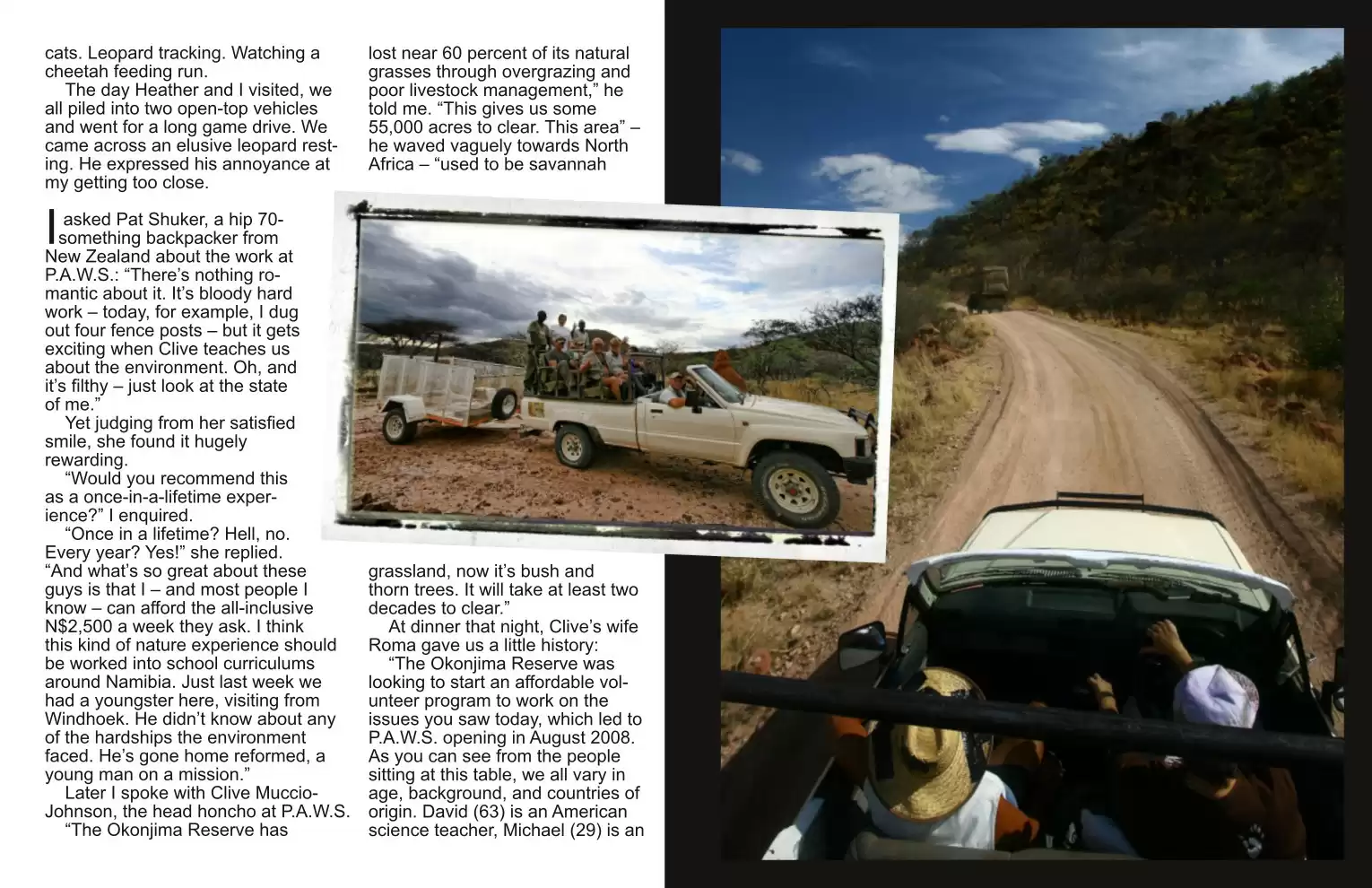
The day Heather and I visited, we all piled into two open-top vehicles and went for a long game drive. We came across an elusive leopard resting. He expressed his annoyance at my getting too close.
I asked Pat Shuker, a hip 70-something backpacker from New Zealand about the work at P.A.W.S.: "There's nothing romantic about it. It's bloody hard work--today, for example, I dug out four fence posts--but it gets exciting when Clive teaches us about the environment. Oh, and it's filthy--just look at the state of me."
Yet judging from her satisfied smile, she found it hugely rewarding.
"Would you recommend this as a once-in-a-lifetime experience?" I enquired.
"Once in a lifetime? Hell, no. Every year? Yes!" she replied. "And what's so great about these guys is that I--and most people I know--can afford the all-inclusive N$2,500 a week they ask. I think this kind of nature experience should be worked into school curriculums around Namibia. Just last week we had a youngster here, visiting from Windhoek. He didn't know about any of the hardships the environment faced. He's gone home reformed, a young man on a mission."
Later I spoke with Clive Muccio-Johnson, the head honcho at P.A.W.S.
"The Okonjima Reserve has lost near 60 percent of its natural grasses through overgrazing and poor livestock management," he told me. "This gives us some 55,000 acres to clear. This area"--he waved vaguely towards North Africa--"used to be savannah grassland, now it's bush and thorn trees. It will take at least two decades to clear."
At dinner that night, Clive's wife Roma gave us a little history:
"The Okonjima Reserve was looking to start an affordable volunteer program to work on the issues you saw today, which led to P.A.W.S. opening in August 2008. As you can see from the people sitting at this table, we all vary in age, background, and countries of origin. David (63) is an American science teacher, Michael (29) is an
| Previous Page | Next Page |
Contents
Features:
Columns & Opinion:
- Rear View Mirror (Richard Truesdell)
- The Road Ahead (Robyn Larson McCarthy)
- Opinion: Spirit of Ecstasy (Carmen Madrid)
- Opinion: Consumer Reports vs. My Lincoln/My Ford (Joseph Babiasz)