
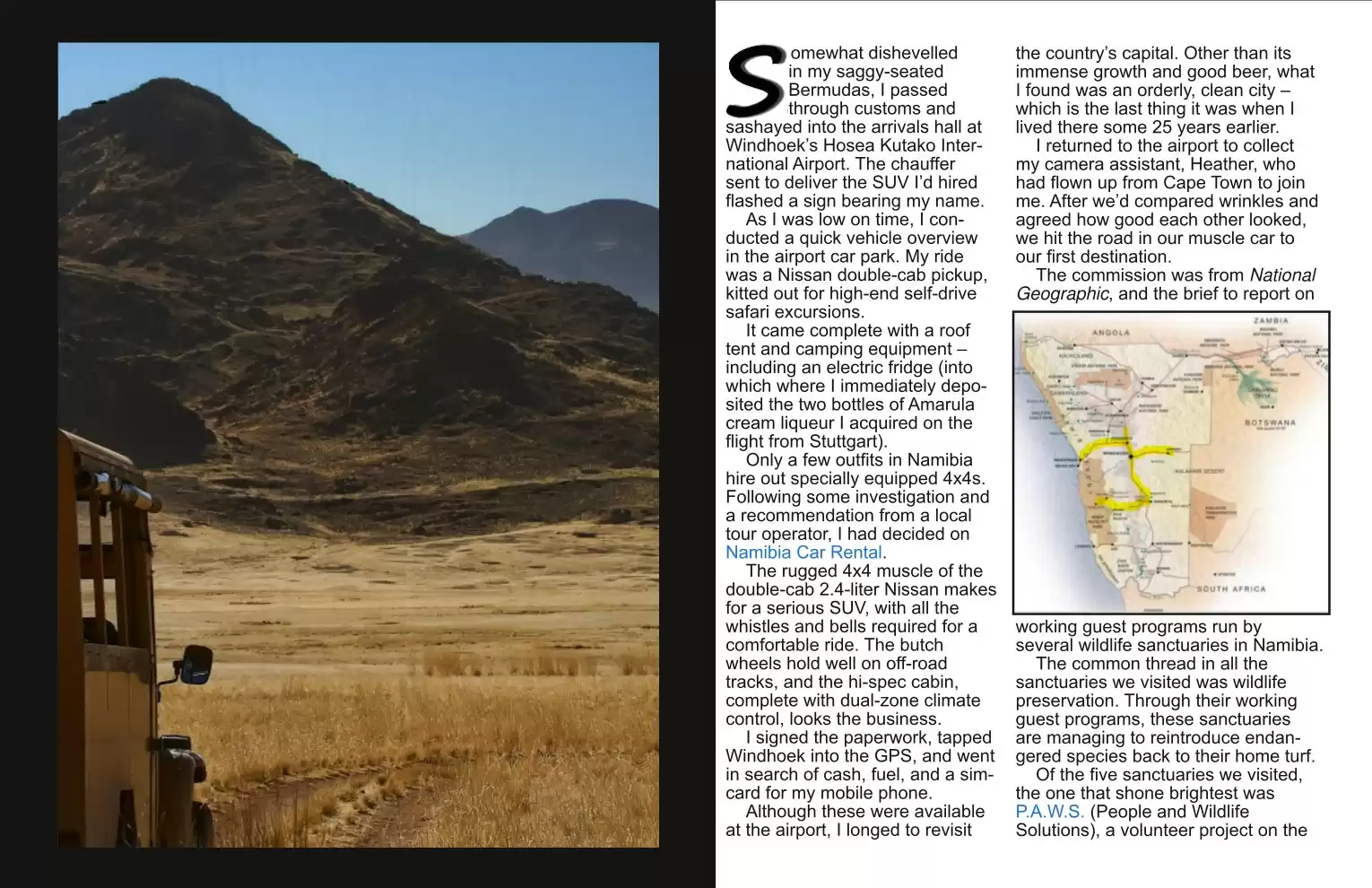
Somewhat dishevelled in my saggy-seated Bermudas, I passed through customs and sashayed into the arrivals hall at Windhoek's Hosea Kutako International Airport. The chauffer sent to deliver the SUV I'd hired flashed a sign bearing my name.
As I was low on time, I con-ducted a quick vehicle overview in the airport car park. My ride was a Nissan double-cab pickup, kitted out for high-end self-drive safari excursions.
It came complete with a roof tent and camping equipment--including an electric fridge (into which where I immediately deposited the two bottles of Amarula cream liqueur I acquired on the flight from Stuttgart).
Only a few outfits in Namibia hire out specially equipped 4x4s. Following some investigation and a recommendation from a local tour operator, I had decided on Namibia Car Rental.
The rugged 4x4 muscle of the double-cab 2.4-liter Nissan makes for a serious SUV, with all the whistles and bells required for a comfortable ride. The butch wheels hold well on off-road tracks, and the hi-spec cabin, complete with dual-zone climate control, looks the business.
I signed the paperwork, tapped Windhoek into the GPS, and went in search of cash, fuel, and a sim-card for my mobile phone. Although these were available at the airport, I longed to revisit the country's capital. Other than its immense growth and good beer, what I found was an orderly, clean city--which is the last thing it was when I lived there some 25 years earlier.
I returned to the airport to collect my camera assistant, Heather, who had flown up from Cape Town to join me. After we'd compared wrinkles and agreed how good each other looked, we hit the road in our muscle car to our first destination.
The commission was from National Geographic, and the brief to report on working guest programs run by several wildlife sanctuaries in Namibia.
The common thread in all the sanctuaries we visited was wildlife preservation. Through their working guest programs, these sanctuaries are managing to reintroduce endangered species back to their home turf.
Of the five sanctuaries we visited, the one that shone brightest was P.A.W.S. (People and Wildlife Solutions), a volunteer project on the
| Previous Page | Next Page |
Contents
Features:
Columns & Opinion:
- Rear View Mirror (Richard Truesdell)
- The Road Ahead (Robyn Larson McCarthy)
- Opinion: Spirit of Ecstasy (Carmen Madrid)
- Opinion: Consumer Reports vs. My Lincoln/My Ford (Joseph Babiasz)