
And while the interior of the current Charger is a mega-improvement over its predecessor, it will never be mistaken for one found in the benchmark M5. But face facts: You can buy a Super Bee for yourself and a V6 Challenger for your significant other for about the same price.
Once settled in behind the wheel, it's time to get to the bottom line: How well does it drive? That question can be answered simply: Nothing that compares with it for anything close to its as-tested price. Period!
To put it in perspective, I like to use the term "driving small." In spite of its obvious bulk, the Charger SRT8 Super Bee feels more responsive than you would expect it to be, making it seem significantly smaller than it is.
Part of this is due to the styling tweaks that came with the introduction of the second-gen version. These include thinner A-pillars up front, a larger windshield, and a reduced C-pillar profile that improves visibility all around. This is combined with a suspension system that has been completely re-engineered, even for the less sporting, non-SRT Chargers.
The benefits of the chassis tuning were immediately apparent on one of my favorite driving roads of the test loop, CA-74 between San Juan Capistrano and Lake Elsinore, California. Much of this twisty segment of tarmac was recently repaved, providing a stern test for any car's handling. It was here I could tell the chassis tuning has paid big dividends. I could easily fling the Super Bee through hairpins so tight you might be in an Alpine pass. In a word, remarkable.
Since I didn't have an M5 to test alongside the Super Bee, I turned to the Internet to check out some recent tests of the benchmark BMW.The results were illuminating.
Zero to 60, Charger: 4.3 seconds. The BMW M5? An almost identical 4.4 seconds. Quarter-mile? The Charger covers 1,320 feet in 12.8 seconds, with the M5 just a tenth of a second quicker. Top speed? No contest out of the box, with the Charger capable of a drag-limited 175 miles per hour, while the M5 is electronically throttled at 155 miles per hour. (If the speed limiter was removed, the M5 would be capable of a top speed of better than 180 miles per hour.)
Base price for the BMW M5? An eye-watering $90,695, basically double the as-tested price of my SRT8 Super Bee. While the M5 is worth the price in many respects, given all the technology BMW packs into it, I have to admire the blunt-force approach Ralph Giles and the SRT team employ.
The New 392 Hemi
For MOPAR aficionados, the number 392 rings a familiar bell: the original HEMI V8 from the Fifties. But that's about the only similarity between the first 392 HEMI and the one found under the hood of the SRT8 Super Bee.
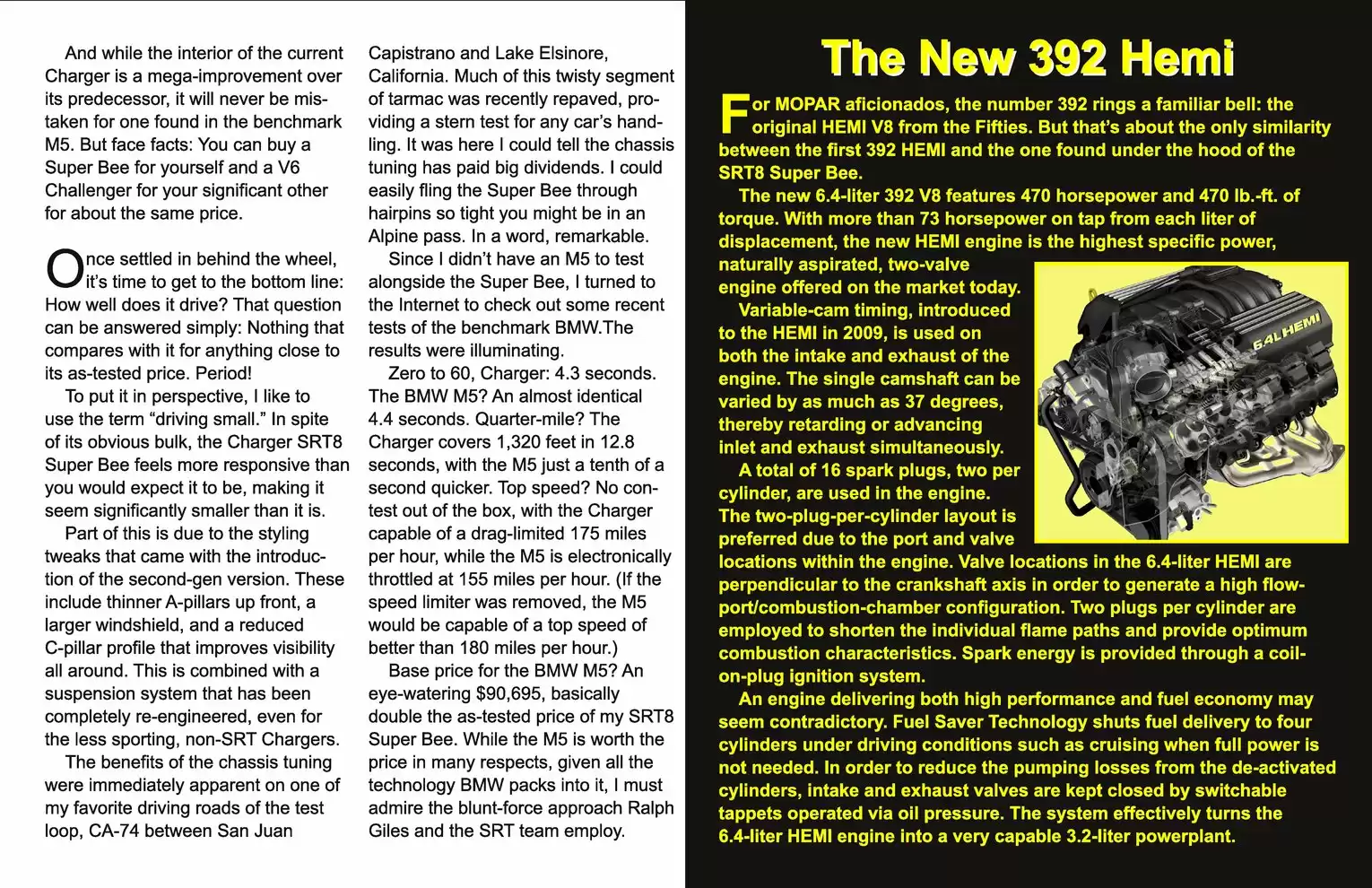
The new 6.4-liter 392 V8 features 470 horsepower and 470 lb.-ft. of torque. With more than 73 horsepower on tap from each liter of displacement, the new HEMI engine is the highest specific power, naturally aspirated, two-valve engine offered on the market today.
Variable-cam timing, introduced to the HEMI in 2009, is used on both the intake and exhaust of the engine. The single camshaft can be varied by as much as 37 degrees, thereby retarding or advancing inlet and exhaust simultaneously.
A total of 16 spark plugs, two per cylinder, are used in the engine. The two-plug-per-cylinder layout is preferred due to the port and valve locations within the engine. Valve locations in the 6.4-liter HEMI are perpendicular to the crankshaft axis in order to generate a high flow-port/combustion-chamber configuration. Two plugs per cylinder are employed to shorten the individual flame paths and provide optimum combustion characteristics. Spark energy is provided through a coil-on-plug ignition system.
An engine delivering both high performance and fuel economy may contradictory. Fuel Saver Technology shuts fuel delivery to four cylinders under driving conditions such as cruising when full power is not needed. In order to reduce the pumping losses from the de-activated cylinders, intake and exhaust valves are kept closed by switchable tappets operated via oil pressure. The system effectively turns the 6.4-liter HEMI engine into a very capable 3.2-liter powerplant.
| Previous Page | Next Page |