
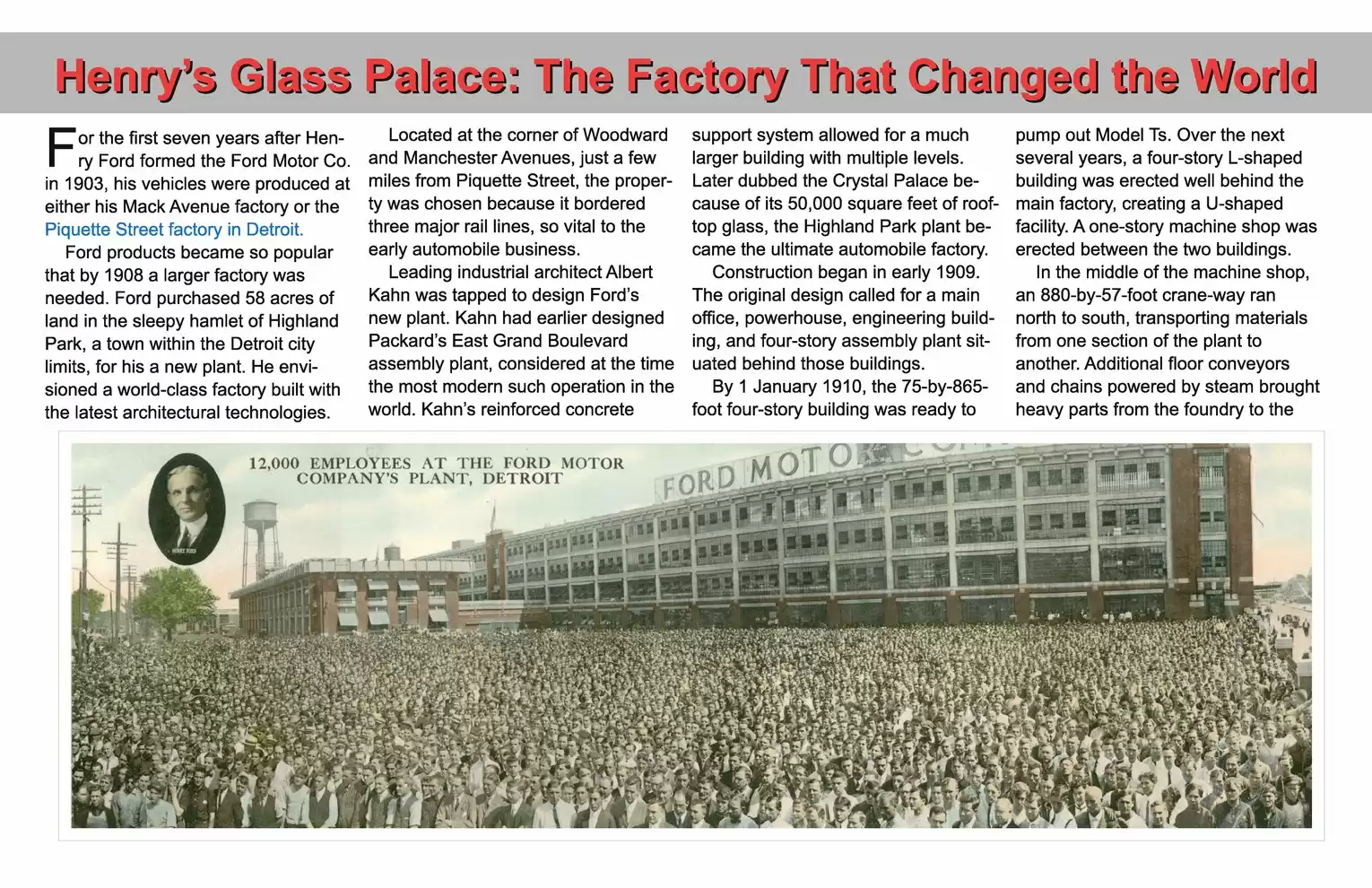
Sidebar: Henry's Glass Palace: The Factory That Changed The World
For the first seven years after Henry Ford formed the Ford Motor Co. in 1903, his vehicles were produced at either his Mack Avenue factory or the Piquette Street factory in Detroit.
Ford products became so popular that by 1908 a larger factory was needed. Ford purchased 58 acres of land in the sleepy hamlet of Highland Park, a town within the Detroit city limits, for his a new plant. He envisioned a world-class factory built with the latest architectural technologies.
Located at the corner of Woodward and Manchester Avenues, just a few miles from Piquette Street, the property was chosen because it bordered three major rail lines, so vital to the early automobile business.
Leading industrial architect Albert Kahn was tapped to design Ford's new plant. Kahn had earlier designed Packard's East Grand Boulevard assembly plant, considered at the time the most modern such operation in the world. Kahn's reinforced concrete support system allowed for a much larger building with multiple levels. Later dubbed the Crystal Palace because of its 50,000 square feet of rooftop glass, the Highland Park plant became the ultimate automobile factory.
Construction began in early 1909. The original design called for a main office, powerhouse, engineering building, and four-story assembly plant situated behind those buildings. By 1 January 1910, the 75-by-865-foot four-story building was ready to pump out Model Ts. Over the next several years, a four-story L-shaped building was erected well behind the main factory, creating a U-shaped facility. A one-story machine shop was erected between the two buildings. In the middle of the machine shop, an 880-by-57-foot crane-way ran north to south, transporting materials from one section of the plant to another. Additional floor conveyors and chains powered by steam brought heavy parts from the foundry to the
| Previous Page | Next Page |