
reflector to bathe the interior in soft, shadow-free light.
Again, I used the fill-flash technique to highlight some of the details on the dash. In this case, the exposure was 2.5 seconds at f 22 for lots of depth of field. Vary the height of the camera on the tripod head to get a higher angle and to eliminate any distracting background elements.
The important thing I was trying to show here was that this truck features a simple dash that is highly stylized with its own Art Deco-themed elements, starkly contrasting with the otherwise spartan look of the interior.
If the undercarriage of your vehicle is noteworthy, shoot it. If you have a set of ramps, use them. As it can be difficult to use a tripod in such situations, a small beanbag can be used to support and position the camera. Use your self-timer to avoid any chance of camera shake spoiling the shot.
Static Exterior Shots
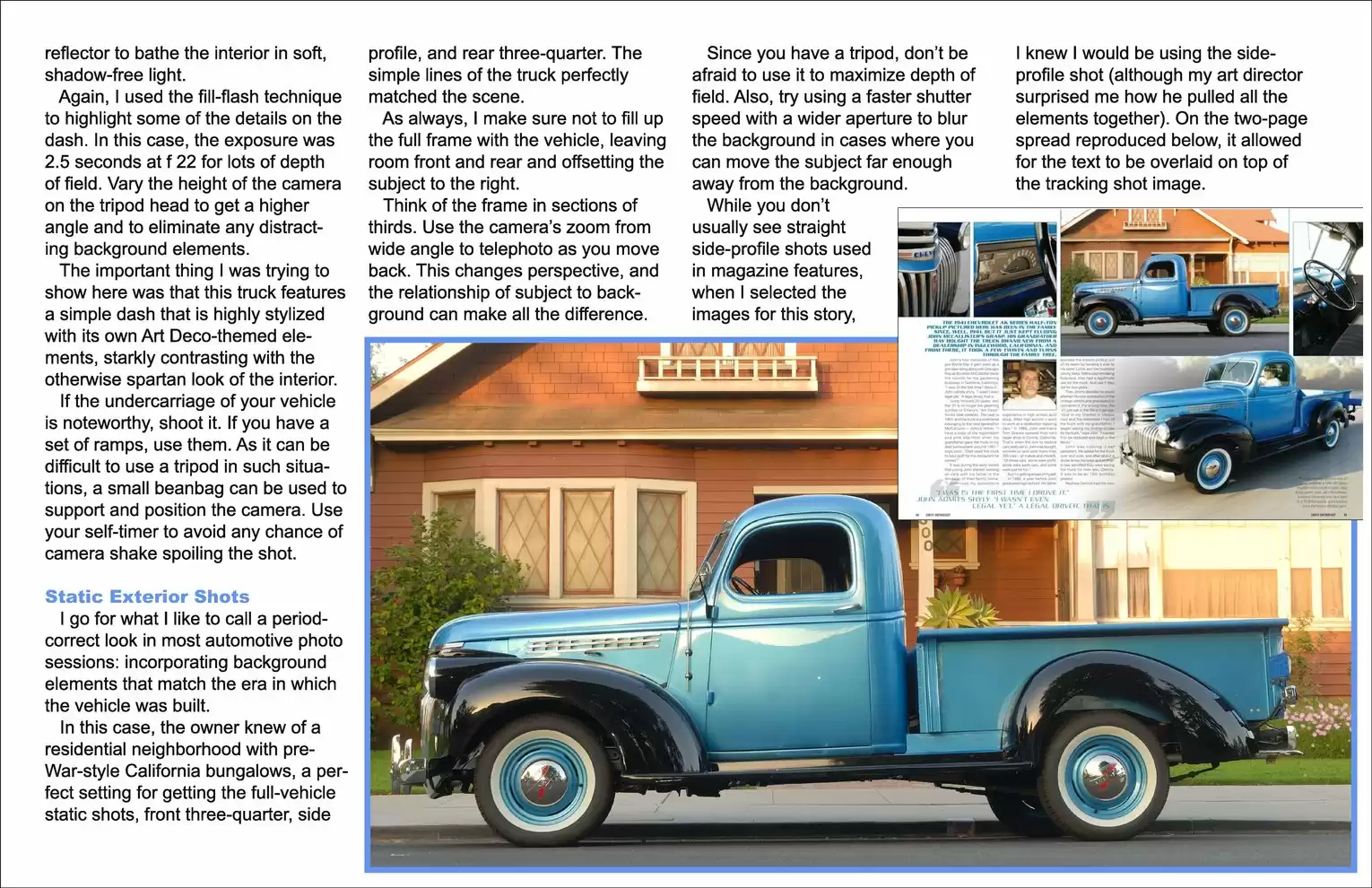
I go for what I like to call a period-correct look in most automotive photo sessions: incorporating background elements that match the era in which the vehicle was built. In this case, the owner knew of a residential neighborhood with pre-War-style California bungalows, a perfect setting for getting the full-vehicle static shots, front three-quarter, side profile, and rear three-quarter. The simple lines of the truck perfectly matched the scene. As always, I make sure not to fill up the full frame with the vehicle, leaving room front and rear and offsetting the subject to the right.
Think of the frame in sections of thirds. Use the camera's zoom from wide angle to telephoto as you move back. This changes perspective, and the relationship of subject to back-ground can make all the difference.
Since you have a tripod, don't be afraid to use it to maximize depth of field. Also, try using a faster shutter speed with a wider aperture to blur the background in cases where you can move the subject far enough away from the background.
While you don't usually see straight side-profile shots used in magazine features, when I selected the images for this story, I knew I would be using the side-profile shot (although my art director surprised me how he pulled all the elements together). On the two-page spread reproduced below, it allowed for the text to be overlaid on top of the tracking shot image.
| Previous Page | Next Page |