
It was on a back-roads detour that I had my most pleasant surprise. While the 4,100-pound Genesis sedan was probably sprung softer than I prefer, it proved to be very competent on the twisty secondary roads northeast of San Diego. Even more surprising was when it came time to top off the tank, the 2011 Genesis returned a surprising 21.5 miles per gallon, well above the EPA combined rating of 19.
I got my seat time in the Genesis at the tail end of the third year of the car's lifecycle, so the competition (most specifically, the Chrysler 300) has time to close the gap. Yet when the points are tallied, the Genesis sedan still strikes me as the more compelling value proposition.
With a substantially upgraded refresh on the horizon for 2012--a more powerful and efficient five-liter V8, an eight-speed automatic transmission, and all-wheel drive--I fully expect Hyundai to up the ante and continue to stay at or near the top of its class. The high-priced German competition, in particular, should stay in the Asian automaker's rear-view mirrors.
As the introductions of the 2012 models near, expect Hyundai dealers to be in a mood to wheel and deal--keeping in mind that, compared to other luxury sedans in the under-$50,000 category, few hold their value as well as the Genesis.
In one fell swoop, the Asian automaker changed forever its perception in the marketplace with its Hyundai 2011 Genesis sedan.
Sidebar: Hyundai's Genesis Coupe Spec-R
Sharing its rear-wheel-drive platform with the Genesis luxury sedan is the sporty Genesis coupe. Oddly enough, having spent time in the Genesis sedan, I can say the coupe doesn't look or feel anything like its sedan counterpart.
First, it's smaller on the outside. A full 13.6 inches shorter than the sedan, the coupe shares no exterior sheet metal, not even the sedan's elegant Mercedes-Benz-like front clip.
Inside, the luxurious appointments, especially the upscale design of the instrument panel, were replaced by a design much more in keeping with a base-model price of just $23,100. This is not necessarily a bad thing, simply a statement of what one sees from the driver's seat of the Genesis coupe.
That said, let's look at the coupe's obvious direct competitors--the V6 versions of the Chevy Camaro, the Dodge Challenger, and the Ford Mustang--with the previously driven sedan as a benchmark. Can South Korea build a viable competitor to America's current trio of pony cars?
Certainly, the Genesis coupe is a clear upgrade over the car it replaced in Hyundai's constantly upgraded U.S. lineup. That car was the smaller, less powerful Tiburon sports coupe, which left the lineup in 2009.
Hyundai thoughtfully provided Automotive Traveler with the enthusiast-focused version of the Genesis coupe. The R-Spec edition is powered by the new-for-2011 3.8 V6, producing 306 horsepower and mated to a six-speed manual transmission. No automatic option is available on either R-Spec model. (A 306-horsepower turbocharged four powers the second R-Spec model.)
To keep the base price at a reasonable $26,750, the R-Spec doesn't include automatic headlights, Xenon HID headlights, or the 6.5-inch navigation system. XM Radio with a 90-day subscription is standard--to be expected these days when customers want to keep on top of the news.
In addition to the discreet R-Spec badges, other standard equipment includes such performance upgrades as the track-tuned suspension, Brembo brakes, Torsen limited-slip differential, and front camber adjustment bolts.
An appealing package overall, the 2011 Genesis coupe does suffer from something of an identity crisis. In addition to competing with its domestic counterparts, the Genesis coupe (especially in its R-Spec guise) competes against cars in what could be considered a class above: the Infiniti G37 coupe and even the BMW 335. In this regard, the coupe doesn't bridge the perception gap as well as its sedan counterpart does.
Also an issue is the Genesis coupe's zero-to-60 sprint. Although less than six seconds marks it as fast, subjectively it does not feel as quick.
When it comes to stopping power, however, the R-Spec is at the top of its class. I can attest to this from personal experience: A driver on I-215 who was probably too busy texting to pay attention to his vehicle strayed into my lane, requiring a panic stop to avoid either a rear-ender or an impromptu meeting with the center divider. Thanks, Hyundai.
Although the company does not publicly break out sales figures separately, it's no industry secret that sales of the Genesis coupe have fallen short of expectations. Considering that Hyundai addressed some early criticisms of the 2010 model with running changes for 2011, expect the company to continue to fine tune the package. This is one automaker that truly listens to both the hypercritical press and its loyal customers.
Rumors continue to swirl that all-wheel-drive versions of both the sedan and the coupe are coming for 2012. With an all-wheel-drive option, sales are sure to pick up in cold-weather markets where dealing with snow is an important concern.
With a comfortable, well-appointed interior, a strong feature set for the price, and Hyundai's renowned warranty coverage, I expect the Genesis coupe will end up on the shopping lists of an ever-greater number of buyers.
Technology in Motion: Lexicon Logic7 17-Speaker Premium Audio System
I should mention that I spent the first 20 years of my career in the aftermarket mobile electronics retail arena, first as a car stereo store owner and then as the editor of the Autotronics section in Motor Trend circa 1995. So, I have something of an affinity for great sound in a mobile environment.
When the Genesis Concept sedan was introduced at the 2008 New York International Automobile Show, standing next to me was Steven Ernst of Harman International. It was Steven who served as the sales liaison between the engineering teams at Hyundai and Harman, and who told me, "Wait until you hear the Logic7 premium sound system in the Genesis. It's a 17-speaker Lexicon system."
My experience with the Logic7 platform went back to 1999 when, at the invitation of Harman's Matt Munn, I visited the Harman Skunkwerks in Karls-bad, Germany after attending the Frankfurt International Automobile Show. In a Saab test vehicle, I had the chance to experience fully the immersive capabilities of Harman's state-of-the-art automotive audio platform, in prototype at the time.
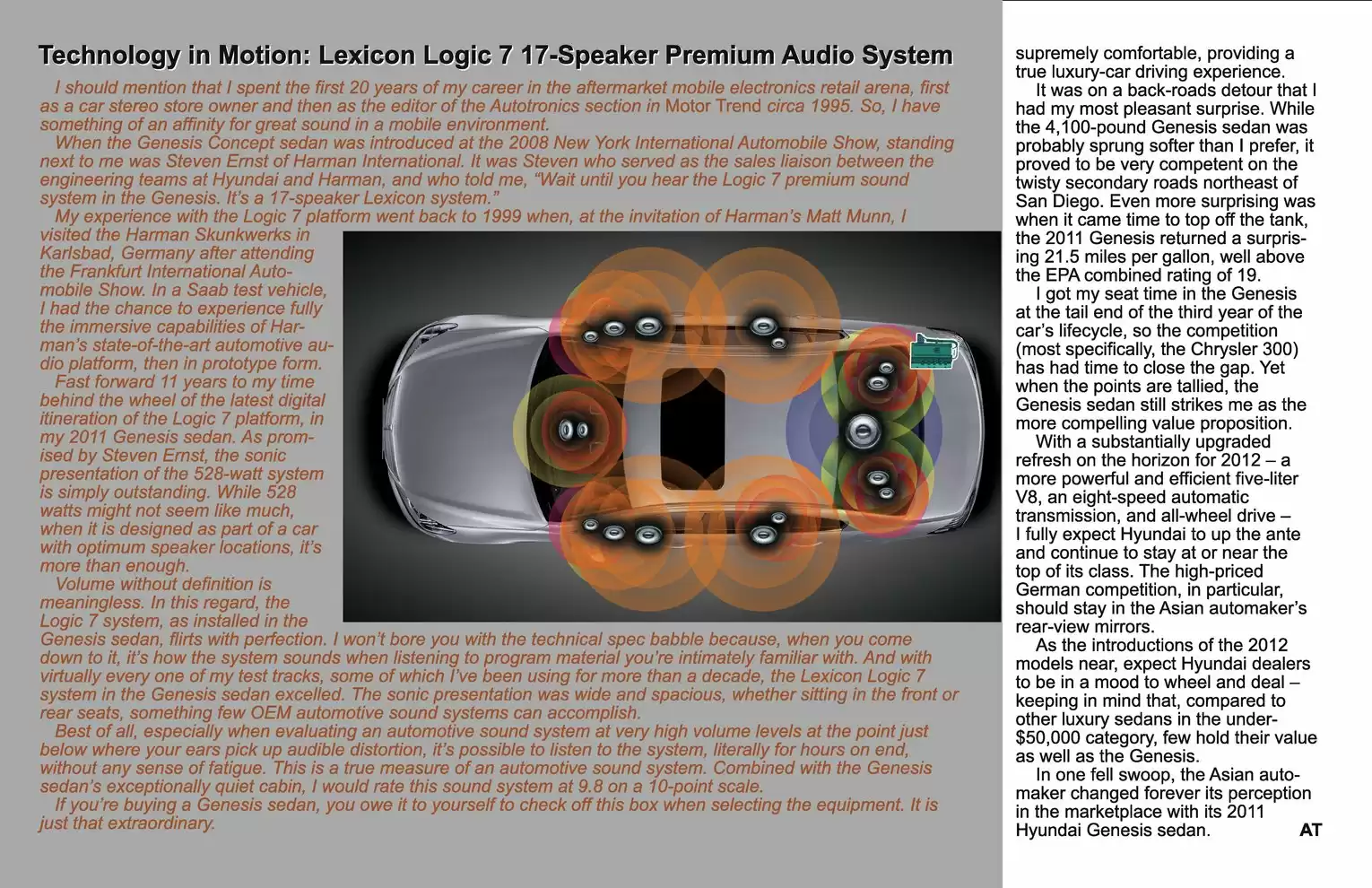
Fast forward 11 years to my time behind the wheel of the latest digital itineration of the Logic7 platform, in my 2011 Genesis sedan. As promised by Steven Ernst, the sonic presentation of the 528-watt system. While 528 watts might not seem like much, when it is designed as part of a car with optimum speaker locations, it's more than enough.
Volume without definition is meaningless. In this regard, the Logic7 system, as installed in the Genesis sedan, flirts with perfection. I won't bore you with the technical spec babble because, when you come down to it, it's how the system sounds when listening to program material you're intimately familiar with. And with virtually every one of my test tracks, some of which I've been using for more than a decade, the Lexicon Logic 7 system in the Genesis sedan excelled. The sonic presentation was wide and spacious, whether sitting in the front or rear seats, something few OEM automotive sound systems can accomplish.
Best of all, especially when evaluating an automotive sound system, especially at very high volume levels at the point just below your ears pick up audible distortion, it's possible to listen to the system, literally for hours on end, without any sense of fatigue. This is a true measure of an automotive sound system. Combined with the Genesis sedan's exceptionally quiet cabin, I would rate this sound system at 9.8 on a 10-point scale. If you're buying a Genesis sedan, you owe it to yourself to check off this box when selecting the equipment. It's simply that outstanding.
| Previous Page | Next Page |
Contents
Features:
Departments:
- Contributors
- Behind the Wheel: 2011 Hyundai Genesis
- Behind the Wheel: 2011 Chrysler 200 Limited
- Not Found on eBay
- Travel and Book Reviews
- Travel News
- Auto News
- Cruising Round-Up