
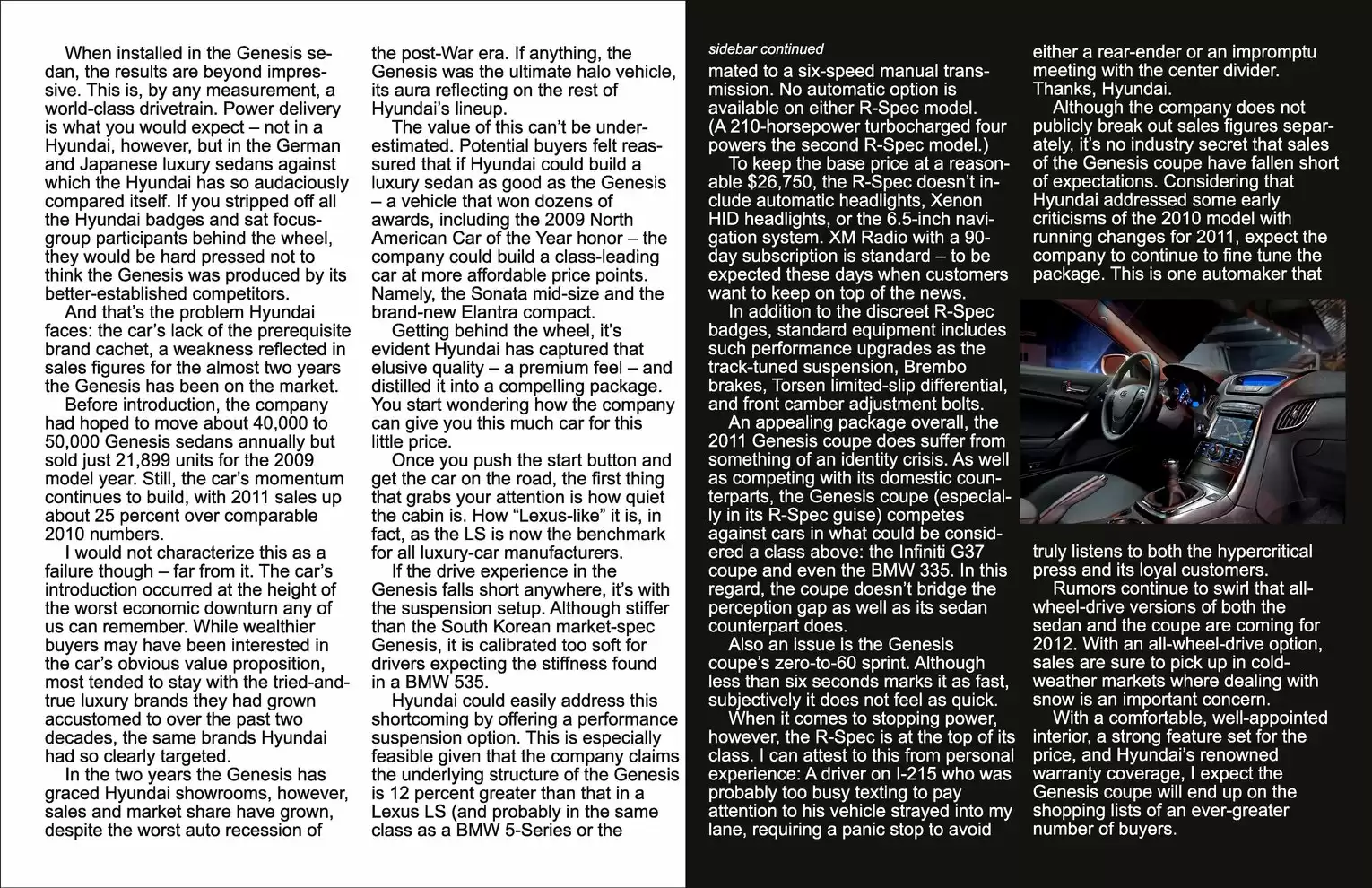
When installed in the Genesis sedan, the results are beyond impressive. This is, by any measurement, a world-class drivetrain. Power delivery is what you would expect--not in a Hyundai, however, but in the German and Japanese luxury sedans against which the Hyundai has so audaciously compared itself. If you stripped off all the Hyundai badges and sat focus-group participants behind the wheel, they would be hard pressed not to think the Genesis was produced by its better-established competitors.
And that's the problem Hyundai faces: the car's lack of the prerequisite brand cachet, a weakness reflected in sales figures for the almost two years the Genesis has been on the market. Before introduction, Hyundai had hoped to move about 40,000 to 50,000 Genesis sedans annually but sold just 21,899 units for the 2009 model year. Still, the car's momentum continues to build, with 2011 sales up about 25 percent over comparable 2010 numbers.
I would not characterize this as a failure though--far from it. The car's introduction occurred at the height of the worst economic downturn any of us can remember. While wealthier buyers may have been interested in the car's obvious value proposition, most tended to stay with the tried-and-true luxury brands they had grown accustomed to over the past two decades, the same brands Hyundai had so clearly targeted.
In the two years the Genesis has graced Hyundai showrooms, however, sales and market share have grown, despite the worst auto recession of the post-War era. If anything, the Genesis was the ultimate halo vehicle, its aura reflecting on the rest of Hyundai's lineup.
The value of this can't be underestimated. Potential buyers felt reassured that if Hyundai could build a luxury sedan as good as the Genesis--a vehicle that won dozens of awards, including the 2009 North American Car of the Year honor--the company could build a class-leading car at more affordable price points. Namely, the Sonata mid-size and the brand-new Elantra compact.
Getting behind the wheel, it's evident Hyundai has captured that elusive quality--a premium feel--and distilled it into a compelling package. You start wondering how Hyundai can give you this much car for this little price.
Once you push the start button and get the car on the road, the first thing that grabs your attention is how quiet the cabin is. How "Lexus-like" it is, in fact, as the LS is now the benchmark for all luxury-car manufacturers.
If the drive experience in the Genesis falls short anywhere, it's with the suspension setup. Although stiffer than the South Korean market-spec Genesis, it is calibrated too soft for drivers expecting the stiffness found in a BMW 535.
Hyundai could easily address this shortcoming by offering a performance suspension option. This is especially feasible given that the company claims the underlying structure of the Genesis is 12 percent greater than that in a Lexus LS (and probably in the same class as a BMW 5-Series or the
| Previous Page | Next Page |
Contents
Features:
Departments:
- Contributors
- Behind the Wheel: 2011 Hyundai Genesis
- Behind the Wheel: 2011 Chrysler 200 Limited
- Not Found on eBay
- Travel and Book Reviews
- Travel News
- Auto News
- Cruising Round-Up