
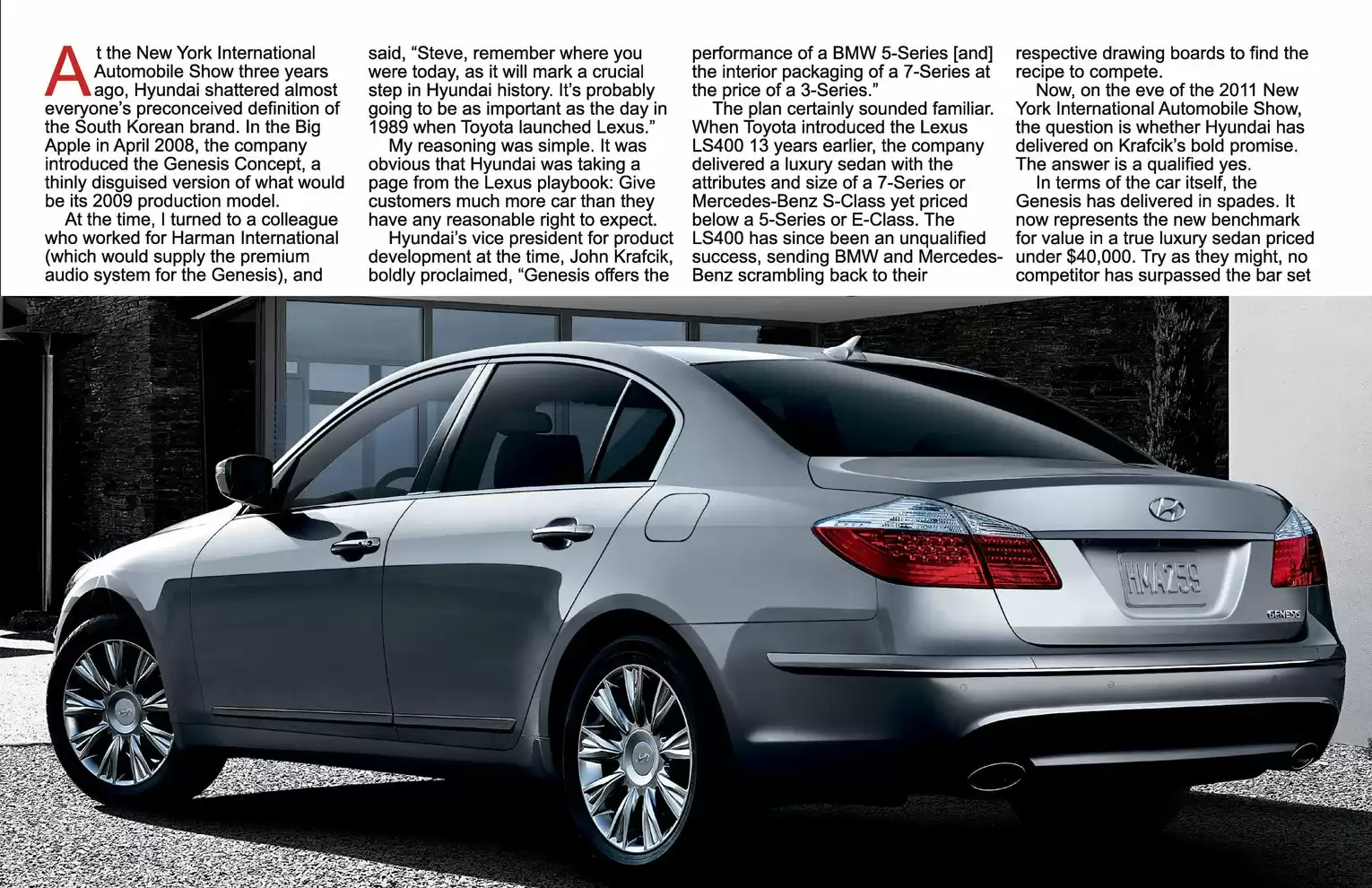
At the New York International Automobile Show three years ago, Hyundai shattered almost everyone's preconceived definition of the South Korean brand. In the Big Apple in April 2008, the company introduced the Genesis Concept, a thinly disguised version of what would be its 2009 production model.
At the time, I turned to a colleague who worked for Harman International (which would supply the premium audio system for the Genesis), and said, "Steve, remember where you were today, as it will mark a crucial step in Hyundai history. It's probably going to be as important as the day in 1989 when Toyota launched Lexus."
My reasoning was simple. It was obvious that Hyundai was taking a page from the Lexus playbook: Give customers much more car than they have any reasonable right to expect.
Hyundai's vice president for product development at the time, John Krafcik, boldly proclaimed, "Genesis offers the performance of a BMW 5-Series [and] the interior packaging of a 7-Series at the price of a 3-Series."
The plan certainly sounded familiar. When Toyota introduced the Lexus LS400 13 years earlier, the company delivered a luxury sedan with the attributes and size of a 7-Series or Mercedes-Benz S-Class yet priced below a 5-Series or E-Class. The LS400 has since been an unqualified success, sending BMW and Mercedes-Benz scrambling back to their respective drawing boards to find the recipe to compete.
Now, on the eve of the 2011 New York International Automobile Show, the question is whether Hyundai has delivered on Krafcik's bold promise. The answer is a qualified yes.
In terms of the car itself, the Genesis has delivered in spades. It now represents the new benchmark for value in a true luxury sedan priced under $40,000. Try as they might, no competitor has surpassed the bar set
| Previous Page | Next Page |
Contents
Features:
Departments:
- Contributors
- Behind the Wheel: 2011 Hyundai Genesis
- Behind the Wheel: 2011 Chrysler 200 Limited
- Not Found on eBay
- Travel and Book Reviews
- Travel News
- Auto News
- Cruising Round-Up