
Even more than 50 years after it ushered in the turbine car age to the general public, the Chrysler Turbine Car still strikes a distinctive profile in this photograph taken in front of the W. P. Chrysler Museum in 2006. It should be noted that the museum shut its doors to the public at the end of 2012. It remains the hope of many Mopar enthusiasts that it will re-open in the future.
twins toured major auto shows in Los Angeles, San Francisco, California, Kansas City, Missouri, St Louis, Missouri, Detroit, Cleveland, Ohio, and more than 80 other US cities. Another Turbo Dart and Turbo Fury were added to the turbine car test fleet, allowing Chrysler to expand its promotional efforts to reach hundreds of thousands of potential customers.
Fourth Generation (1962-1966)
The Ghia-bodied Chrysler Turbine Car was powered by Chrysler's fourth-generation gas turbine engine. Producing 130 horsepower, it was the most efficient Chrysler gas turbine engine yet. Spinning at 44,500 revolution per minute, this version could burn diesel fuel, unleaded gasoline (in very limited availability back in 1963), kerosene, JP-4 jet fuel (available at general aviation facilities), even vegetable oil. The President of Mexico ran a Chrysler Turbine Car on tequila. Best of all, no adjustment was required when changing fuels, think of the Chrysler Turbine Car as being the first flex-fuel vehicle.
With this advanced and refined drivetrain, the Turbine Car would sprint from zero to 60 miles per hour in 12 seconds. While that doesn't sound fast today, it was competitive with other similarly-sized cars with small V8 engines.
The exhaust did not produce measurable carbon monoxide, or raw hydrocarbons, but produced high levels of nitrogen oxides. Going forward this issue would bedevil the program as increasingly stringent emission standards were introduced in the early 1970s.
The Chrysler Turbine Cars were equipped with a lightly modified version of Chrysler's TorqueFlite automatic transmission but because of the engine's design, it didn't require a torque converter but instead used gear-reduction system.
At the end of the program, all but five cars, which were donated to museums, were crushed. This was due to import duties that would have been assessed on their Italian-built Ghia bodies.
Fifth, Sixth, and Seventh Generation (1966-1979)
Following the conclusion of the Chrysler Turbine loaner-car program, which was considered an unqualified success, Chrysler continued gas turbine engine development. Next up was a turbine-powered concept car that was a precursor to the 1966 Dodge Charger. A sixth-generation engine finally solved the nitrogen oxide issue and was installed in a 1966 Dodge Coronet.
A lighter, even more efficient seventh-generation gas turbine engine was produced in the early 1970s, when Chrysler received a grant from the Environmental Protection Agency. The next application was to install an updated version into a specially bodied 1977 Chrysler LeBaron coupe. But by this time, Chrysler had become mired in another financial crisis requiring US government loan guarantees to avoid bankruptcy. One stipulation of the loan was to abandon its gas turbine engine program with the thinking being that Chrysler needed to spend its resources on mainstream cars like the ubiquitous K-Car.
While Chrysler's work with turbine engines never resulted in a true production gas turbine-powered car, its legacy lives on. Defense contractor Honeywell continued development of larger gas turbine engines. Its AGR1500 gas turbine engine was ultimately installed in the Abrams M1 Battle Tank that was originally developed by Chrysler Defense and ultimately was sold to General Dynamics. In the First Gulf War the Abrams M1 Battle Tank was instrumental in the overwhelming defeat of the Iraqi Army in just 100 hours. AT
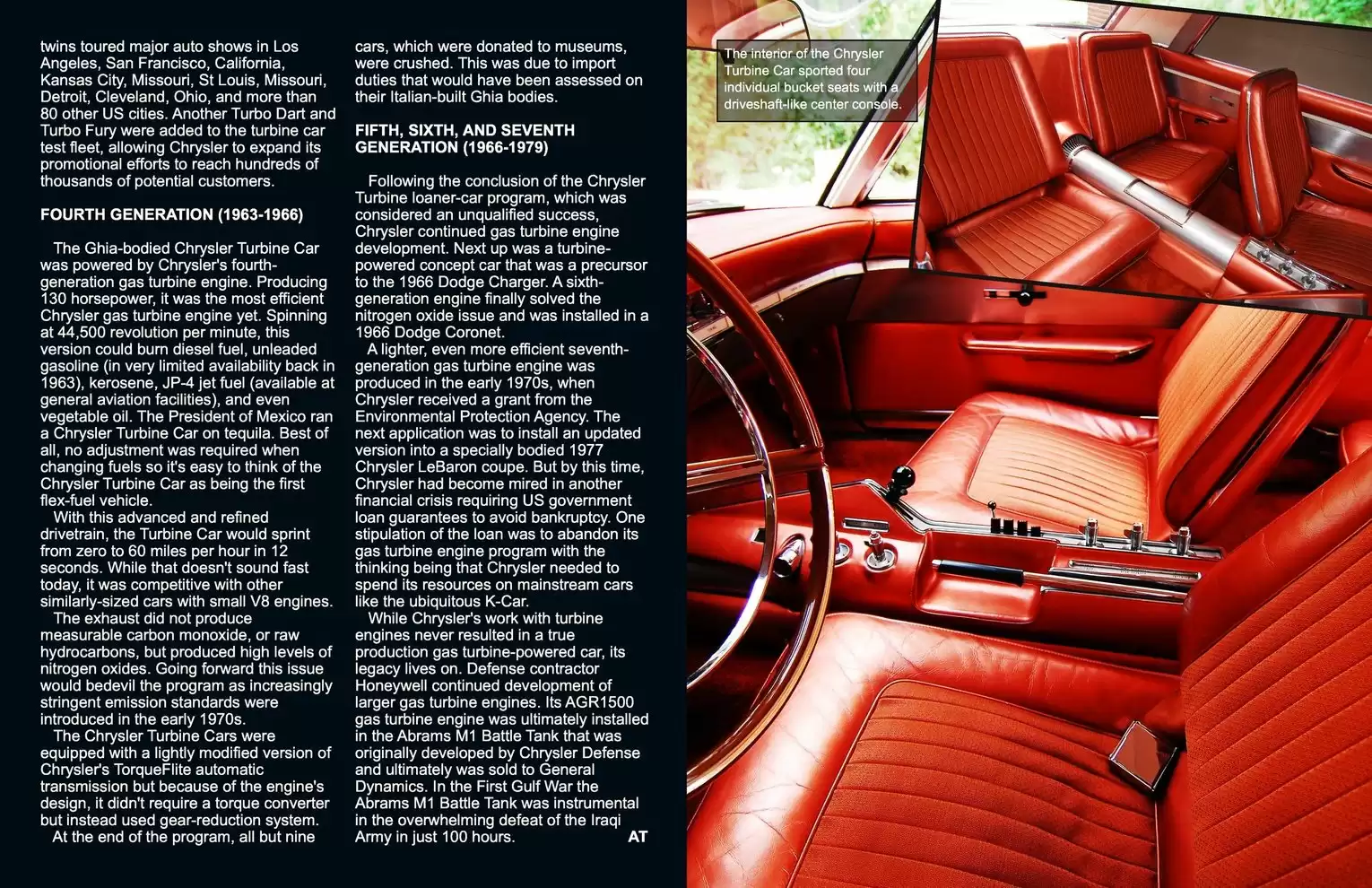
The interior of the Chrysler Turbine Car sported four individual bucket seats with a driveshaft-like center console.
| Previous Page | Next Page |