
day is offered for everyone to get their cars out of the garage and get them track ready.
If you're unfamiliar with autocrossing, know that it's probably the safest of all motorsports (aside from Play-Station's "Need for Speed"). If that desire is to show Mario Andretti how good you are behind the wheel, this is the place to be. Getting your Plymouth Breeze to enter the turnpike at 70 won't impress him. Cracking a clean 50-second run in an autocross might.
Here's how the sport works. The fine club members get access to a parking lot, usually a large corporate lot or the parking area of a major public arena. Philadelphia's SCCA region has held events at the former Nazareth Speedway, the Boeing corporate center, and Citizen's Bank Park.
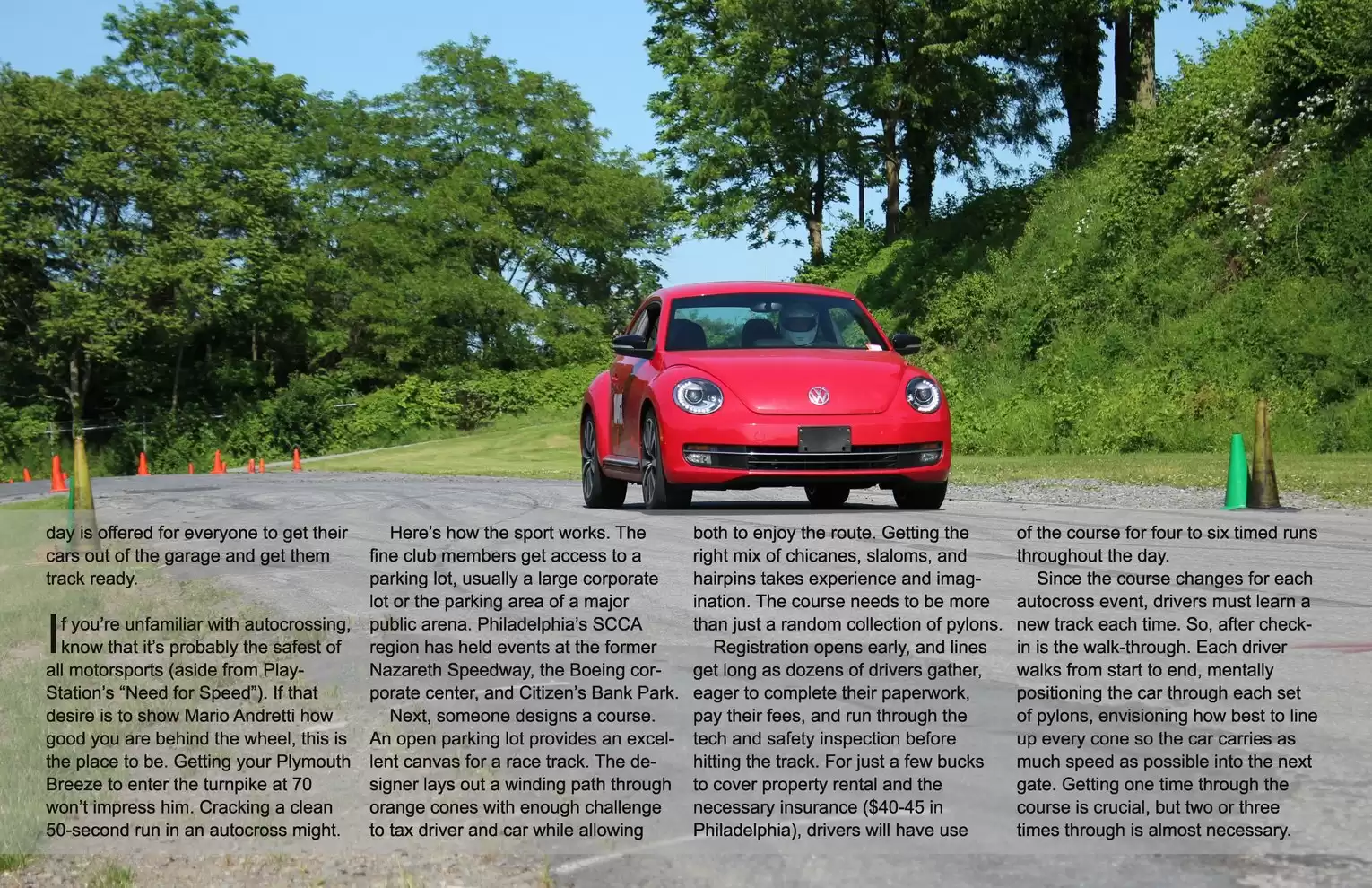
Next, someone designs a course. An open parking lot provides an excellent canvas for a race track. The designer lays out a winding path through orange cones with enough challenge to tax driver and car while allowing both to enjoy the route. Getting the right mix of chicanes, slaloms, and hairpins takes experience and imagination. The course needs to be more than just a random collection of pylons.
Registration opens early, and lines get long as dozens of drivers gather, eager to complete their paperwork and run through the tech and safety inspection before hitting the track. For just a few bucks to cover property rental and the necessary insurance ($40-45 in Philadelphia), drivers will have use of the course for four to six timed runs throughout the day.
Since the course changes for each autocross event, drivers must learn a new track each time. So, after check-in is the walk-through. Each driver walks from start to end, mentally positioning the car through each set of pylons, envisioning how best to line up every cone so the car carries as much speed as possible into the next gate. Getting one time through the course is crucial, but two or three times through is almost necessary.
| Previous Page | Next Page |