
shot a cover with a one-megapixel point-and-shoot camera.)
I use a pro-grade Nikon D200, but you can achieve great results with almost any good point-and-shoot camera that gives you a manual-override capability. The great thing about modern digital cameras is that you can review your photos as you take them.
After I get the first sequence of tracking shots, I review them on the camera's LCD screen, zooming into the front license plate of any badging on the front third of the vehicle. If it looks sharp and crisp, I move on to the next shot on my list.
Detail Shots
In this session, the detail shots were next on my list. I usually try to find a clean, white building, typically in an industrial park, to get the detail shots. This allows me to park the vehicle in the shade so my shots will not be affected by harsh shadows that conceal the details.
This is a good point to mention the most important tool you'll need to achieve professional results: a tripod, the best $30 you'll ever spend on your photographic gear.
By the time we started with the detail shots, it was around 6:30 p.m. This meant I could set the camera on the tripod, using the camera's built-in meter to set my initial exposure. I then adjusted the shutter speed to a slower setting, which allowed me to use a smaller aperture for good depth of field, resulting in crisp, sharp images.
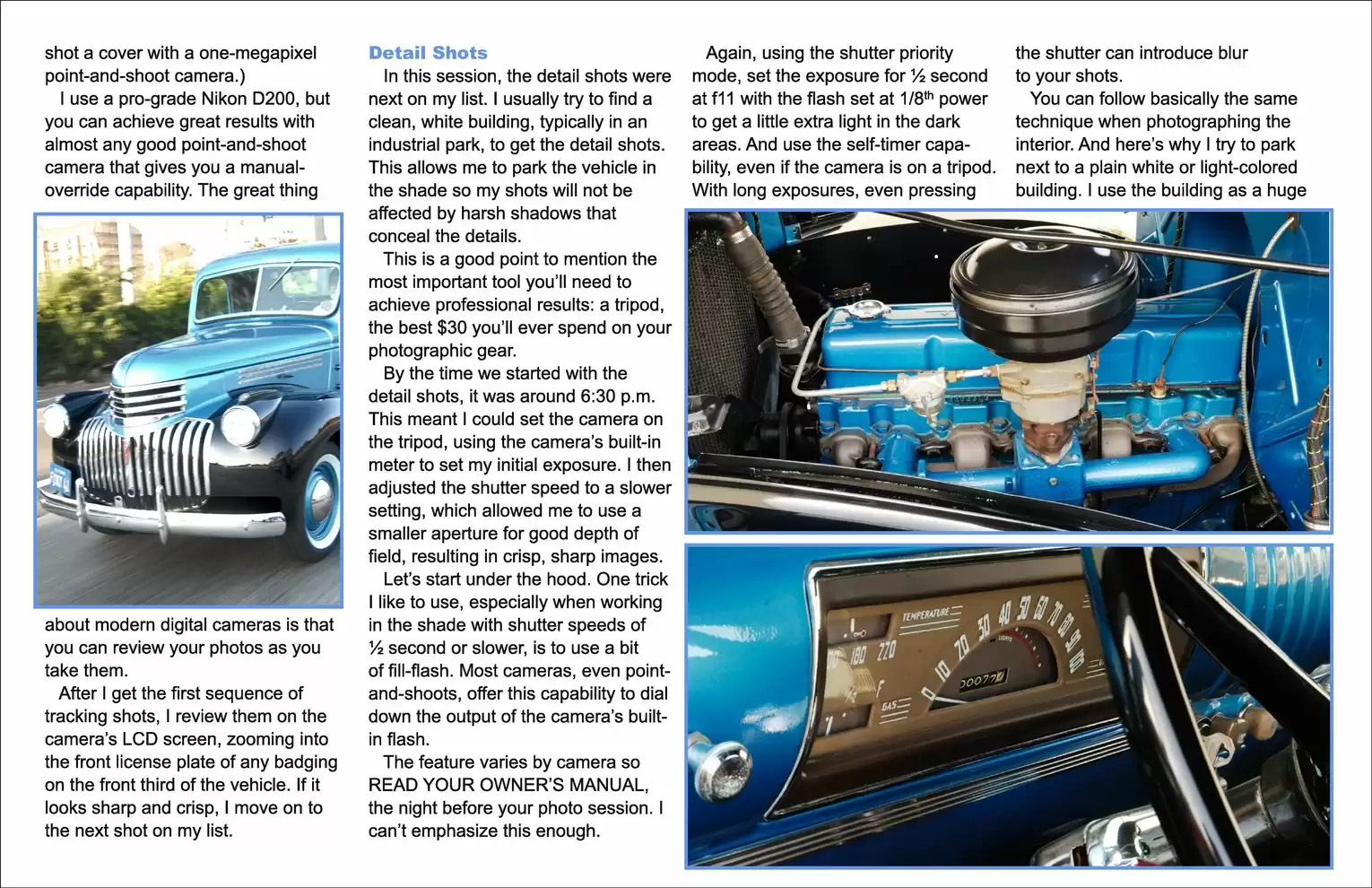
Let's start under the hood. One trick I like to use, especially when working in the shade with shutter speeds of ½ second or slower, is to use a bit of fill-flash. Most cameras, even point-and-shoots, offer this capability to dial down the output of the camera's built-in flash.
The feature varies by camera so READ YOUR OWNER'S MANUAL, the night before your photo session. I can't emphasize this enough.
Again, using the shutter priority mode, set the exposure for ½ second at f11 with the flash set at 1/8th power to get a little extra light in the dark areas. And use the self-timer capability, even if the camera is on a tripod. With long exposures, even pressing the shutter can introduce blur to your shots.
You can follow basically the same technique when photographing the interior. And here's why I try to park next to a plain white or light-colored building. I use the building as a huge
| Previous Page | Next Page |