
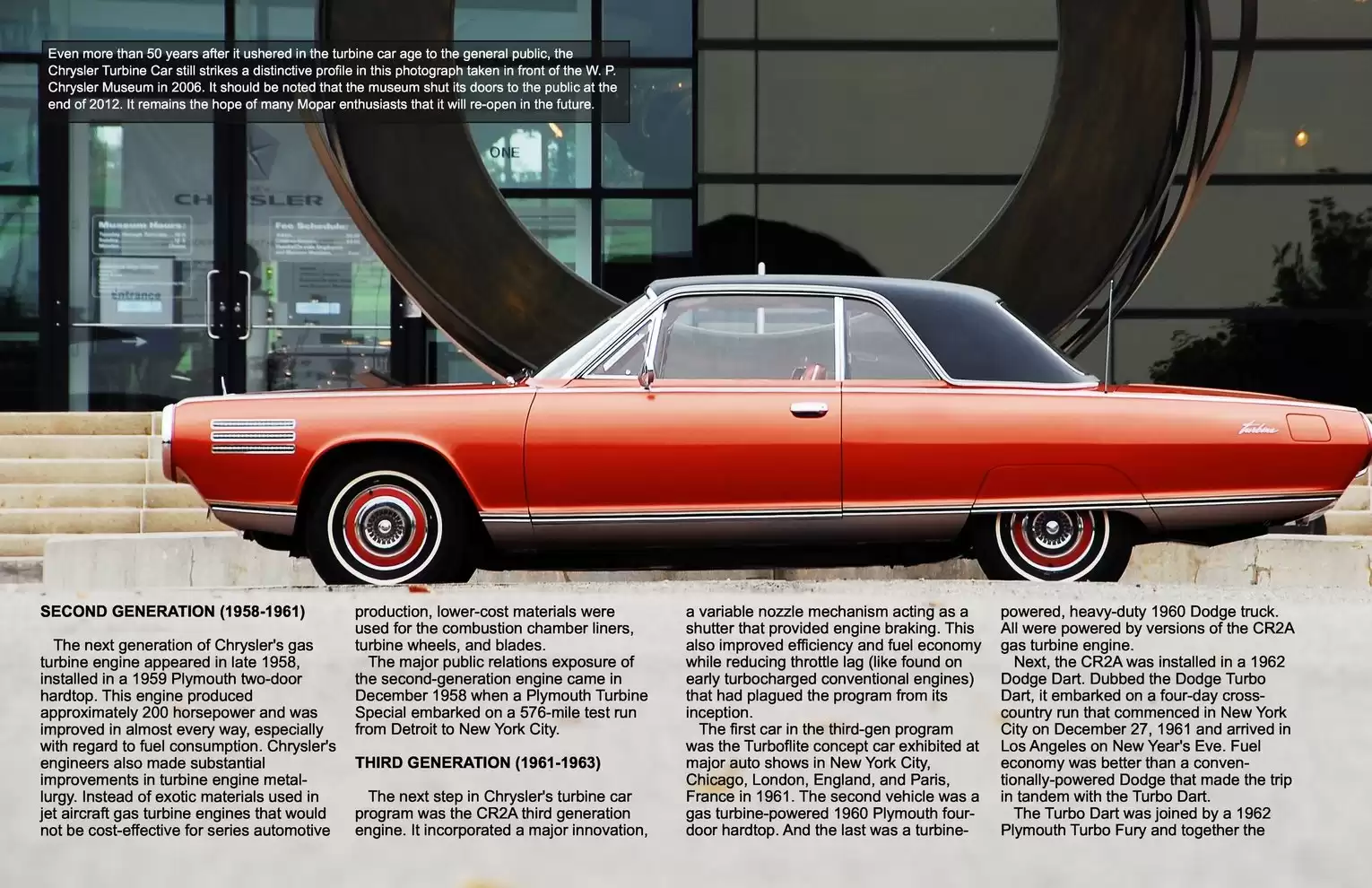
Back in 2006 Automotive Traveler's editorial director Rich Truesdell had the opportunity to fulfill a life long dream, to drive one of the Chrysler Turbine Cars. Thanks to his contacts at Chrysler, he took a spin around Chrysler's Tech Center in Auburn Hills, Michigan, one of the five remaining examples belonging to the W. P. Chrysler Museum.
Second Generation (1958-1961)
The next generation of Chrysler's gas turbine engine appeared in late 1958, installed in a 1959 Plymouth two-door hardtop. This engine produced approximately 200 horsepower and was improved in almost every way, especially with regard to fuel consumption. Chrysler's engineers also made substantial improvements in turbine engine metal-lurgy. Instead of exotic materials used in jet aircraft gas turbine engines that would not be cost-effective for series automotive production, lower-cost materials were used for the combustion chamber liners, turbine wheels, and blades.
The major public relations exposure of the second-generation engine came in December 1958 when a Plymouth Turbine Special embarked on a 576-mile test run from Detroit to New York City.
Third Generation (1961-1963)
The next step in Chrysler's turbine car program was the CR2A third generation engine. It incorporated a major innovation, a variable nozzle mechanism acting as a shutter that provided engine braking. This also improved efficiency and fuel economy while reducing throttle lag (like found on early turbocharged conventional engines) that had plagued the program from its inception.
The first car in the third-gen program was the Turboflite concept car exhibited at major auto shows in New York City, Chicago, London, England, and Paris, France in 1961. The second vehicle was a gas turbine-powered 1960 Plymouth four-door hardtop. And the last was a turbine-powered, heavy-duty 1960 Dodge truck. All were powered by versions of the CR2A gas turbine engine.
Next, the CR2A was installed in a 1962 Dodge Dart. Dubbed the Dodge Turbo Dart, it embarked on a four-day cross-country run that commenced in New York City on December 27, 1961 and arrived in Los Angeles on New Year's Eve. Fuel economy was better than a conven-tionally-powered Dodge that made the trip in tandem with the Turbo Dart.
The Turbo Dart was joined by a 1962 Plymouth Turbo Fury and together the
| Previous Page | Next Page |