
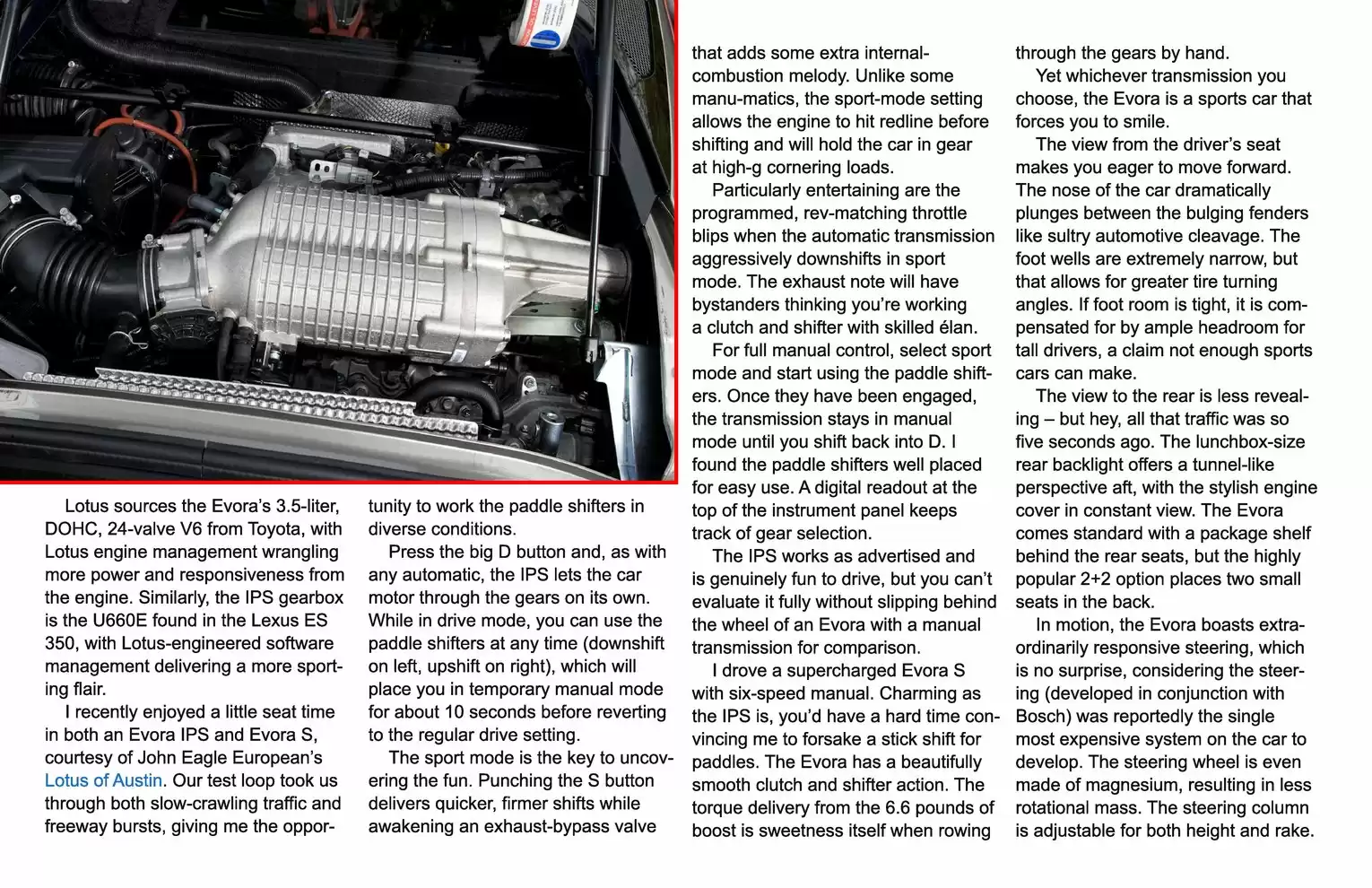
Lotus sources the Evora's 3.5-liter, DOHC, 24-valve V6 from Toyota, with Lotus engine management wrangling more power and responsiveness from the engine. Similarly, the IPS gearbox is the U660E found in the Lexus ES 350, with Lotus-engineered software management delivering a more sporting flair.
I recently enjoyed a little seat time in both an Evora IPS and Evora S, courtesy of John Eagle European's Lotus of Austin. Our test loop took us through both slow-crawling traffic and freeway bursts, giving me the opportunity to work the paddle shifters in diverse conditions.
Press the big D button and, as with any automatic, the IPS lets the car motor through the gears on its own. While in drive mode, you can use the paddle shifters at any time (downshift on left, upshift on right), which will place you in temporary manual mode for about 10 seconds before reverting to the regular drive setting.
The sport mode is the key to uncovering the fun. Punching the S button delivers quicker, firmer shifts while awakening an exhaust-bypass valve that adds some extra internal-combustion melody. Unlike some manu-matics, the sport-mode setting allows the engine to hit redline before shifting and will hold the car in gear at high-g cornering loads.
Particularly entertaining are the programmed, rev-matching throttle blips when the automatic transmission aggressively downshifts in sport mode. The exhaust note will have bystanders thinking you're working a clutch and shifter with skilled élan.
For full manual control, select sport mode and start using the paddle shifters. Once they have been engaged, the transmission stays in manual mode until you shift back into D. I found the paddle shifters well placed for easy use. A digital readout at the top of the instrument panel keeps track of gear selection.
The IPS works as advertised and is genuinely fun to drive, but you can't evaluate it fully without slipping behind the wheel of an Evora with a manual transmission for comparison. I drove a supercharged Evora S with six-speed manual. Charming as the IPS is, you'd have a difficult time convincing me to forsake a stick shift for paddles. The Evora has a beautifully smooth clutch and shifter action. The torque delivery from the 6.6 pounds of boost is sweetness itself when rowing through the gears by hand.
Yet whichever transmission you choose, the Evora is a sports car that forces you to smile.
The view from the driver's seat makes you eager to move forward. The nose of the car dramatically plunges between the bulging fenders like sultry automotive cleavage. The foot wells are extremely narrow, but that allows for greater tire turning angles. If foot room is tight, it is compensated for by ample headroom for tall drivers, a claim not enough sports cars can make.
The view to the rear is less revealing--but hey, all that traffic was so five seconds ago. The lunchbox-size rear backlight offers a tunnel-like perspective aft, with the stylish engine cover in constant view. The Evora comes standard with a package shelf behind the rear seats, but the highly popular 2+2 option places two small seats in the back.
In motion, the Evora boasts extraordinarily responsive steering, which is no surprise, considering the steering (developed in conjunction with Bosch) was reportedly the single most expensive system on the car to develop. The steering wheel is even made of magnesium, resulting in less rotational mass. The steering column is adjustable for both height and rake.
| Previous Page | Next Page |