
Next up was the suspension system. Completely reworked from its Teutonic origins, it offered more sporting characteristics (even on the non-SRT versions) without sacrificing the ride quality expected in a large, rear-wheel-drive American sedan.
The new Charger, also sporting an all-new, much-improved V6 engine, offered a combination of features unrivaled in the sub-$30K category. Here was a full-size sedan that took the battle to its domestic front-wheel-drive competitors, and won. (Many of these upgrades were mirrored in the Chrysler 300, with which the Charger shares its basic platform but which is styled more towards a luxury buyer.)
Then there's the SRT8 Charger, my test car. It embodies all of the upgrades incorporated on mainstream Chargers, enhanced with a 6.4-liter, 392-cubic-inch heart transplant. And it works, big time.
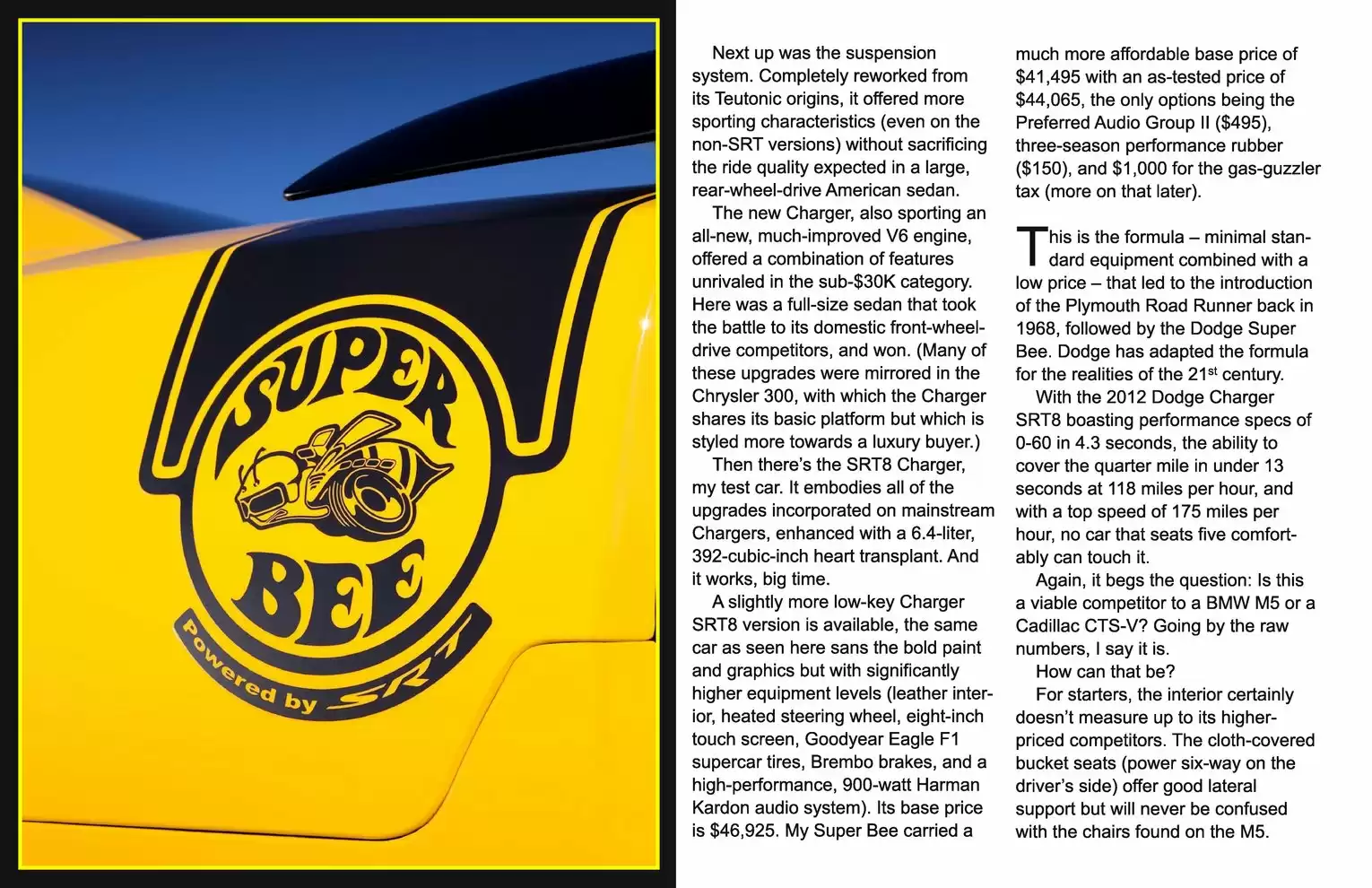
A slightly more low-key Charger SRT8 version is available, the same car as seen here sans the bold paint and graphics but with significantly higher equipment levels (leather interior, heated steering wheel, eight-inch touch screen, Goodyear Eagle F1 supercar tires, Brembo brakes, and a high-performance, 900-watt Harman Kardon audio system). Its base price is $46,925. My Super Bee carried a much more affordable base price of $41,495 with an as-tested price of $44,065, the only options being the Preferred Audio Group II ($495), three-season performance rubber ($150), and $1,000 for the gas-guzzler tax (more on that later).
This is the formula--minimal standard equipment combined with a low price--that led to the introduction of the Plymouth Road Runner back in 1968, followed by the Dodge Super Bee. Dodge has adapted the formula for the realities of the 21st century.
With the 2012 Dodge Charger SRT8 boasting performance specs of 0-60 in 4.3 seconds, the ability to cover the quarter mile in under 13 seconds at 118 miles per hour, and with a top speed of 175 miles per hour, no car that seats five comfortably can touch it. Again, it begs the question: Is this a viable competitor to a BMW M5 or a Cadillac CTS-V? Going by the raw numbers, I say it is.
How can that be? For starters, the interior certainly doesn't measure up to its higher-priced competitors. The cloth-covered bucket seats (power six-way on the driver's side) offer good lateral support but will never be confused with the chairs found on the M5.
| Previous Page | Next Page |