
the Belfast to Londonderry route rather than vice versa.
After a few days spent exploring Belfast (see sidebar on Page 5), Ireland's green countryside and coastal views were calling. Packing up the car one beautiful morning, I was told by the concierge that "the first place to stop is Carrickfergus Castle," just eight miles out of the city on the edge of Belfast Lough. Dominating the harbor it protected for centuries, the fortress built between 1180 and 1205 survives as one of Ireland's largest and best-preserved castles. It remained in defensive use until 1928.
Life-size model soldiers posed on ramparts greeted me on approach. Part Madame Tussard's wax creations, part early Disney animatronics, their colorful uniforms make fun photo-ops. Kids love them.
Sidebar: The Unsinkable Ship Brings New Life to Belfast
As we mark the 100th anniversary of one of the worst travel disasters in history this week--the sinking of the RMS Titanic--many people don't realize that Titanic's story began in Belfast, and that her disaster had a terrible legacy for the people of Northern Ireland's capital city.
As Belfast rose to importance during the Industrial Revolution, her shipyards ranked as the biggest in the world. In 1909, the White Star Line commissioned the shipbuilding firm of Harland and Wolff to build three luxury liners: the Titanic, the Olympic, and the Britannic. Some 12,000 Belfast workers, many highly skilled craftsmen, took part in the construction of what was to be the most luxurious ship of the day.
Financed by American industrialist J.P. Morgan, the ship had as its pièce de résistance a Grand Staircase magnificently clad in oak paneling with gilded balustrades and intricate wrought-iron railings and illuminated by a glass dome. When the RMS Titanic glided down the slipway to enter the River Lagan, she was indeed the largest and most beautiful vessel in the world.
When she hit that famous iceberg on 15 April 1912, buckling steel plates and opening a discontinuous seam some 300 feet long, more than 1,500 of the 2,224 people on board perished. Although called unsinkable, she simply was not designed to withstand the forces she encountered. History now puts the blame on the Titanic's captain, who ignored iceberg warnings and continued traveling at an accelerated speed. According to historian Terry Madill, "Following the sinking, H&W instructed their employees never to mention the ship, and the shame lingered in the city for many years."
In the wake of this sad legacy, economic decline and the "Troubles" led Northern Ireland into a lengthy period of transition, and bombings and rioting put it off the tourist map for decades. Today, a rejuvenation of the downtown area and renewed interest in the Titanic are bringing Belfast back to life.
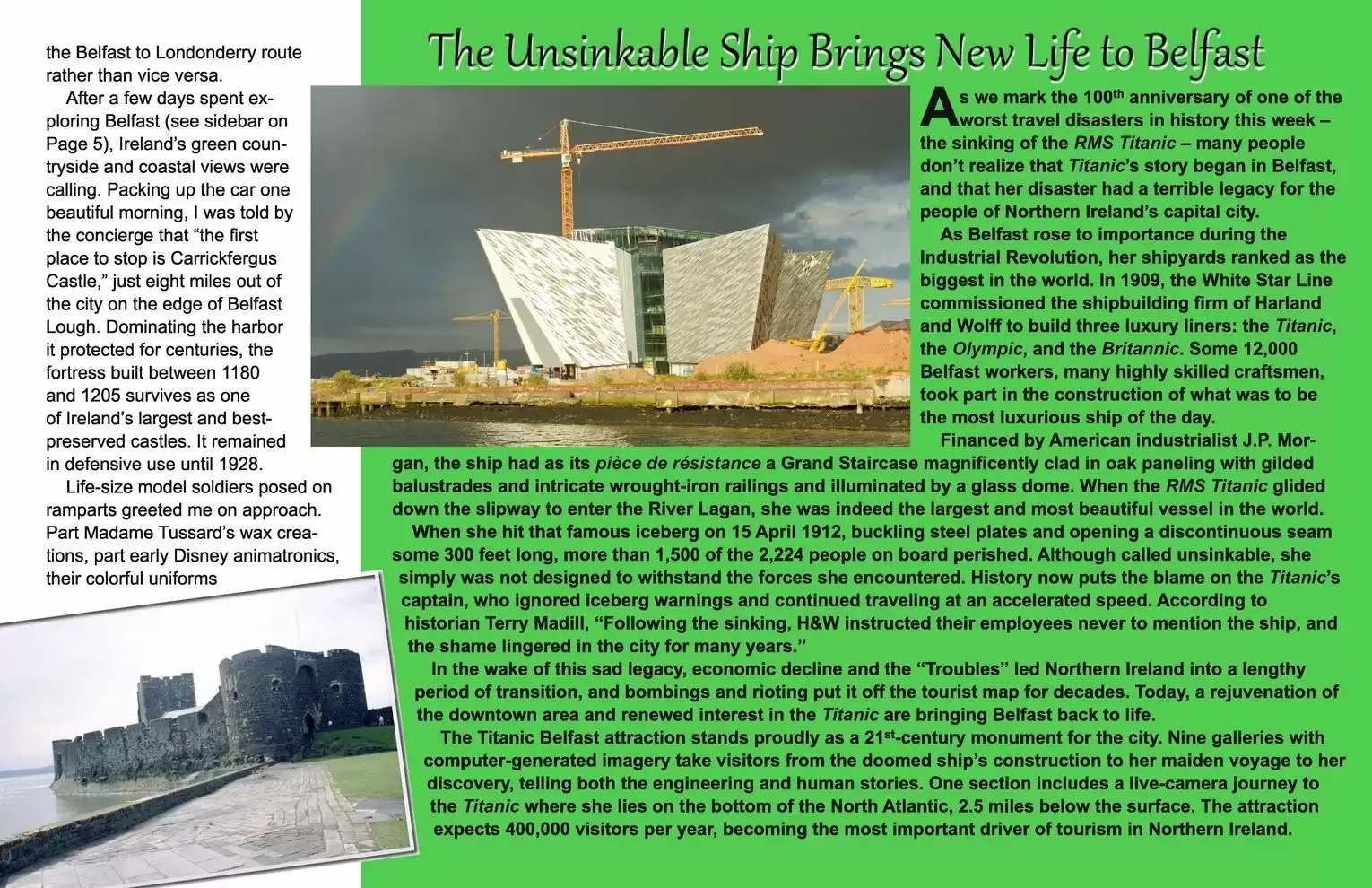
The Titanic Belfast attraction stands proudly as a 21st-century monument for the city. Nine galleries with computer-generated imagery take visitors from the doomed ship's construction to her maiden voyage to her discovery, telling both the engineering and human stories. One section includes a live-camera journey to the Titanic where she lies on the bottom of the North Atlantic, 2.5 miles below the surface. The attraction expects 400,000 visitors per year, becoming the most important driver of tourism in Northern Ireland.
| Previous Page | Next Page |