
The Ford Blue Oval represents one of our country's most legendary companies, a pioneer of the business world that literally put this nation on wheels more than 100 years ago. And at simultaneous events in five cities this Tuesday, the company introduced its boldest statement in a generation: the 2013 Ford Fusion Hybrid.
The 2013 Fusion Hybrid represents Ford's entry into the hyper-competitive mid-sized sedan category that represents almost half of all new cars sold in the United States. The significance of this cannot be underestimated. The move is a shot across the bow of the segment-leading Toyota Camry, Ford's most focused effort to unseat the country's best-selling model.
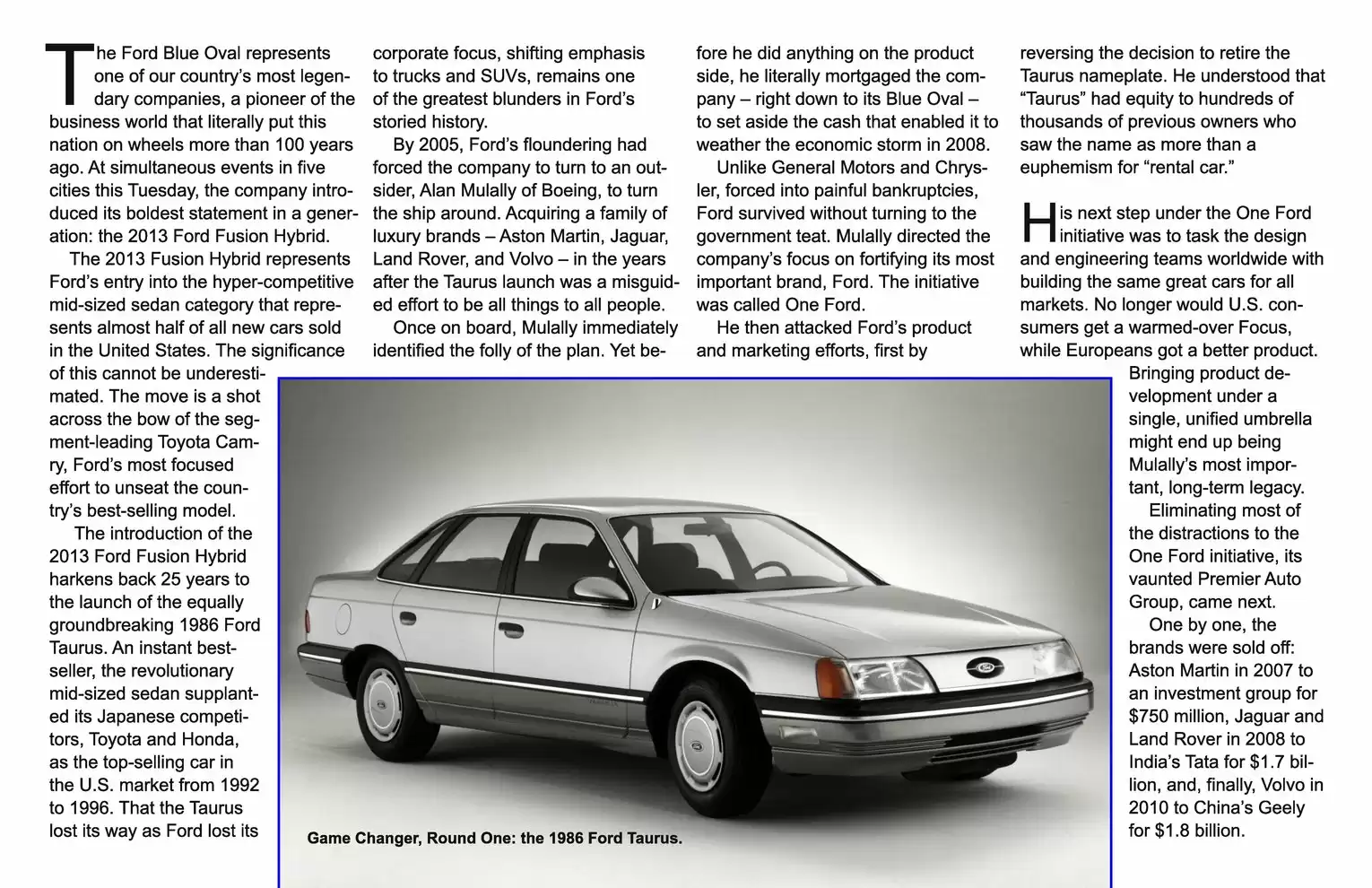
The introduction of the 2013 Ford Fusion Hybrid harkens back 25 years to the launch of the equally groundbreaking 1986 Ford Taurus. An instant bestseller, the revolutionary mid-sized sedan supplanted its Japanese competitors, Toyota and Honda, as the top-selling car in the U.S. market from 1992 to 1996. That the Taurus lost its way as Ford lost its corporate focus, shifting emphasis to trucks and SUVs, remains one of the greatest blunders in Ford's storied history.
By 2005, Ford's floundering had forced the company to turn to an outsider, Alan Mulally of Boeing, to turn the ship around. Acquiring a family of luxury brands--Aston Martin, Jaguar, Land Rover, and Volvo--in the years after the Taurus launch was a misguided effort to be all things to all people. Once on board, Mulally immediately identified the folly of the plan. Yet before he did anything on the product side, he literally mortgaged the company--right down to its Blue Oval--to set aside the cash that enabled it to weather the economic storm in 2008.
Unlike General Motors and Chrysler, forced into painful bankruptcies, Ford survived without turning to the government teat. Mulally directed the company's focus on fortifying its most important brand, Ford. The initiative was called One Ford.
He then attacked Ford's product and marketing efforts, first by reversing the decision to retire the Taurus nameplate. He understood that "Taurus" had equity to hundreds of thousands of previous owners who saw the name as more than a euphemism for "rental car."
His next step under the One Ford initiative was to task the design and engineering teams worldwide with building the same great cars for all markets. No longer would U.S. consumers get a warmed-over Focus, while Europeans got a better product. Bringing product development under a single, unified umbrella might end up being Mulally's most important, long-term legacy.
Eliminating most of the distractions to the One Ford initiative, its vaunted Premier Auto Group, came next. One by one, the brands were sold off: Aston Martin in 2007 to an investment group for $750 million, Jaguar and Land Rover in 2008 to India's Tata for $1.7 billion, and, finally, Volvo in 2010 to China's Geely for $1.8 billion.
| Previous Page | Next Page |