
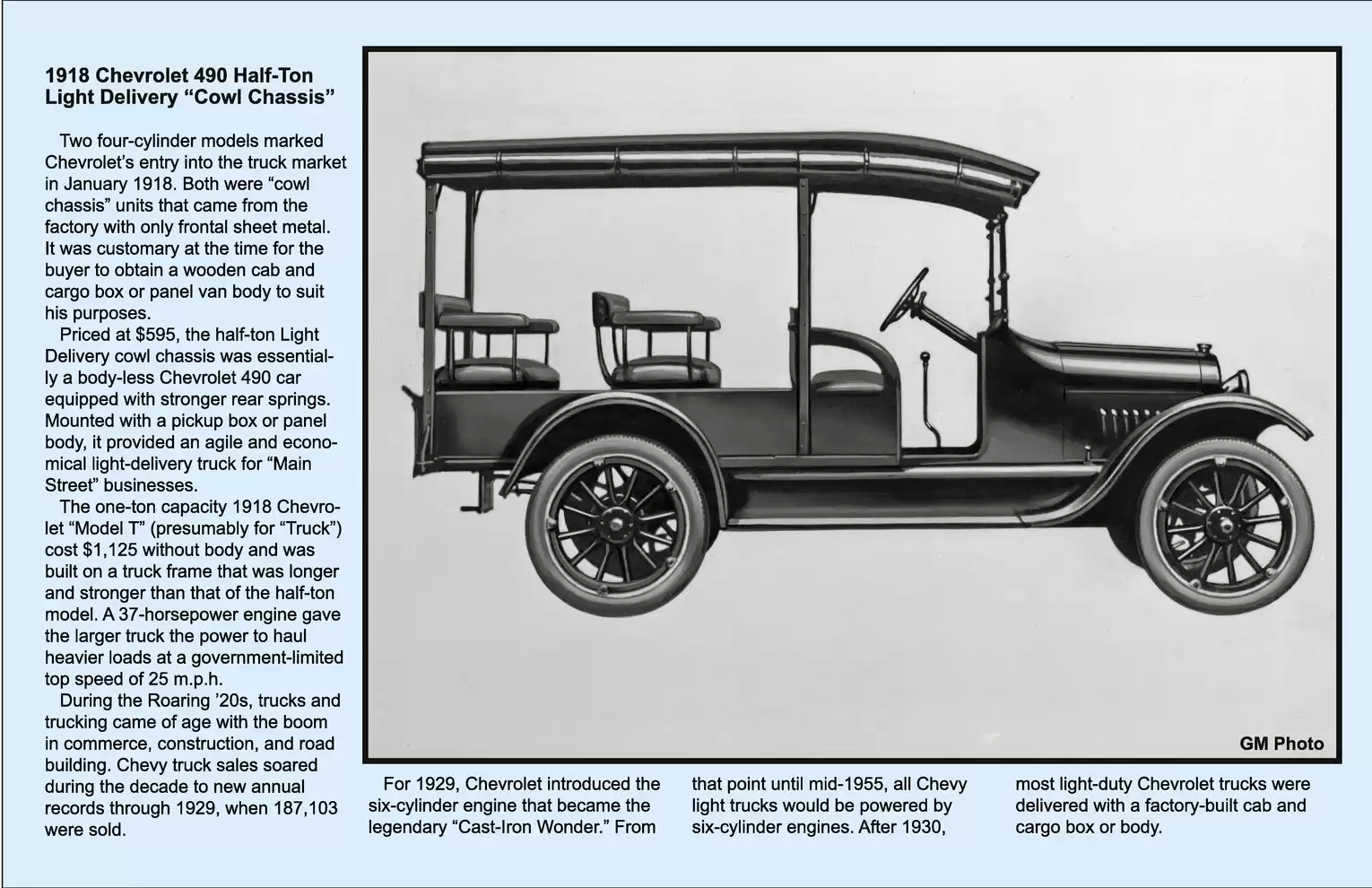
1918 Chevrolet 490 Half-Ton Light Delivery "Cowl Chassis"
Two four-cylinder models marked Chevrolet's entry into the truck market in January 1918. Both were "cowl chassis" units that came from the factory with only frontal sheet metal. It was customary at the time for the buyer to obtain a wooden cab and cargo box or panel van body to suit his purposes.
Priced at $595, the half-ton Light Delivery cowl chassis was essentially a body-less Chevrolet 490 car equipped with stronger rear springs. Mounted with a pickup box or panel body, it provided an agile and economical light-delivery truck for "Main Street" businesses.
The one-ton capacity 1918 Chevrolet "Model T" (presumably for "Truck") cost $1,125 without body and was built on a truck frame that was longer and stronger than that of the half-ton model. A 37-horsepower engine gave the larger truck the power to haul heavier loads at a government-limited top speed of 25 m.p.h.
During the Roaring '20s, trucks and trucking came of age with the boom in commerce, construction, and road building. Chevy truck sales soared during the decade to new annual records through 1929, when 187,103 were sold.
For 1929, Chevrolet introduced the six-cylinder engine that became the legendary "Cast-Iron Wonder." From that point until mid-1955, all Chevy light trucks would be powered by six-cylinder engines. After 1930, most light-duty Chevrolet trucks were delivered with a factory-built cab and cargo box or body.
| Previous Page | Next Page |