
Next to overwrought contemporary luxury sedans, the Pinin looked absolutely out of place in its understated beauty. A simple crease ran the length of the car, piercing the door handles but leaving the sides of the car smooth from the rocker panels through the flush glass to the roof. From front to rear, the bodywork gently wrapped over the passenger compartment with nary a bumper or doodad to mar the surface.
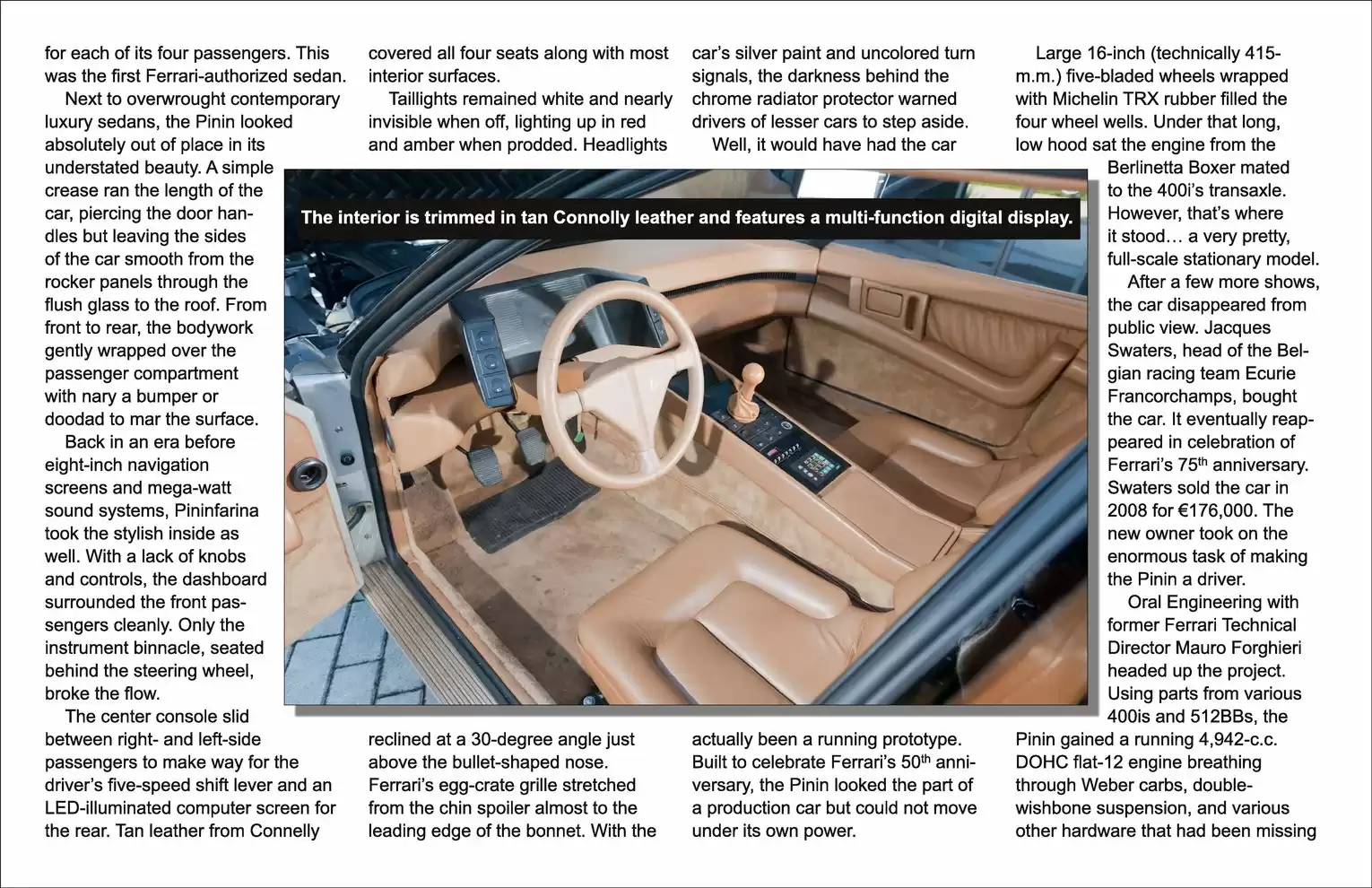
Back in an era before eight-inch navigation screens and mega-watt sound systems, Pininfarina took the stylish inside as well. With a lack of knobs and controls, the dashboard surrounded the front passengers cleanly. Only the instrument binnacle, seated behind the steering wheel, broke the flow. The center console slid between right- and left-side passengers to make way for the driver's five-speed shift lever and an LED-illuminated computer screen for the rear. Tan leather from Connelly covered all four seats along with most interior surfaces.
Taillights remained white and nearly invisible when off, lighting up in red and amber when prodded. Headlights reclined at a 30-degree angle just above the bullet-shaped nose. Ferrari's egg-crate grille stretched from the chin spoiler almost to the leading edge of the bonnet. With the car's silver paint and uncolored turn signals, the darkness behind the chrome radiator protector warned drivers of lesser cars to step aside.
Well, it would have had the car actually been a running prototype. Built to celebrate Ferrari's 50th anniversary, the Pinin looked the part of a production car but could not move under its own power.
Large 16-inch (technically 415-m.m.) five-bladed wheels wrapped with Michelin TRX rubber filled the four wheel wells. Under that long, low hood sat the engine from the Berlinetta Boxer mated to the 400i's transaxle. However, that's where it stood... a very pretty, full-scale stationary model.
After a few more shows, the car disappeared from public view. Jacques Swaters, head of the Belgian racing team Ecurie Francorchamps, bought the car. It eventually reappeared in celebration of Ferrari's 75th anniversary. Swaters sold the car in 2008 for €176,000. The new owner took on the enormous task of making the Pinin a driver.
Oral Engineering with former Ferrari Technical Director Mauro Forghieri headed up the project. Using parts from various 400is and 512BBs, the Pinin gained a running 4,942-c.c. DOHC flat-12 engine breathing through Weber carbs, double-wishbone suspension, and various other hardware that had been missing
| Previous Page | Next Page |