
despair matches the mood of the elderly couple sitting beneath it. They are squabbling quietly. The argument seems to focus on lunch.
"But you didn't even ask if I wanted any," he says, gazing critically at a graveyard of chicken bones. The complaint is immediately contradicted by his wife, who speaks in the unmistakable tones of a veteran contradictor. Perhaps they remained married out of sheer spite, Heather notes.
Chicken bones get me thinking of dinner possibilities. I ask the owner of a neighboring junk shop for a recommendation. She is witchlike, bedecked in armloads of clacking, heavy jewelry--copper, tortoise shell, adamantine. It pleases her, she claims in a voice that grows suitably dramatic, to see visitors come to her country.
"They all seem to fall head over heels in love with my country. And why should they not? The world is a sad enough place and it needs a few points of light, a few places in which people could find comfort." And if South Africa is one of these places, then she is proud of that. "If only more people knew that there is more to Africa than all the problems they see on television."
An evening meal at the picturesque Paddagang Restaurant in Tulbagh's town center is an experience of traditional Boland cuisine. The interior is intimate and atmospheric with yellowwood tables and immense fireplaces. We choose to dine under the full moon and trestled vines.
We are guided to our table by a large woman of an institutional kind now obsolete, yet once found in every hospital wearing a white uniform, starched veil, and sensible shoes with a watch pinned to her rigidly starched breast. Her attentive service assures us a feast of Bobotie and Waterblommetjie Bredie, berry pie dessert--all tastes of the Cape served with generous portions of Afrikaans hospitality (dinner for two was ZAR275, or about $37, including a bottle of wine).
A few miles beyond Tulbagh is Ceres, another picture-postcard fruit-growing town that lies in a peaceful valley shadowed by the Schurweberg Mountains. I am to meet a chap from Ceres Zipline Adventures, who promises me "an awesome eco-adventure," the longest zipslide tour in Africa, one that would take me across amazing rock formations and rivers.
The mere notion of me, an African lady in a traditional generous mould, suspended hundreds of feet off the ground from a thin rope truly scares me--and why I accepted the offer still evades me. My mind rationalizes the prospect: It would be useful, I tell Heather. I am not quite sure in what way, but I am sure to learn something from it. While I am being harnessed, I conclude that this is going to be the way I die. I spend a few moments thinking about my will, then, in an air of finality, I step off the cliff to my death.
Instead, I fly across the dense forest, flailing wildly. I'm definitely no adrenalin junkie, as one 12-year-old zipliner helpfully points out to his dad before strutting off speaking of further fearsome things done in the great outdoors.
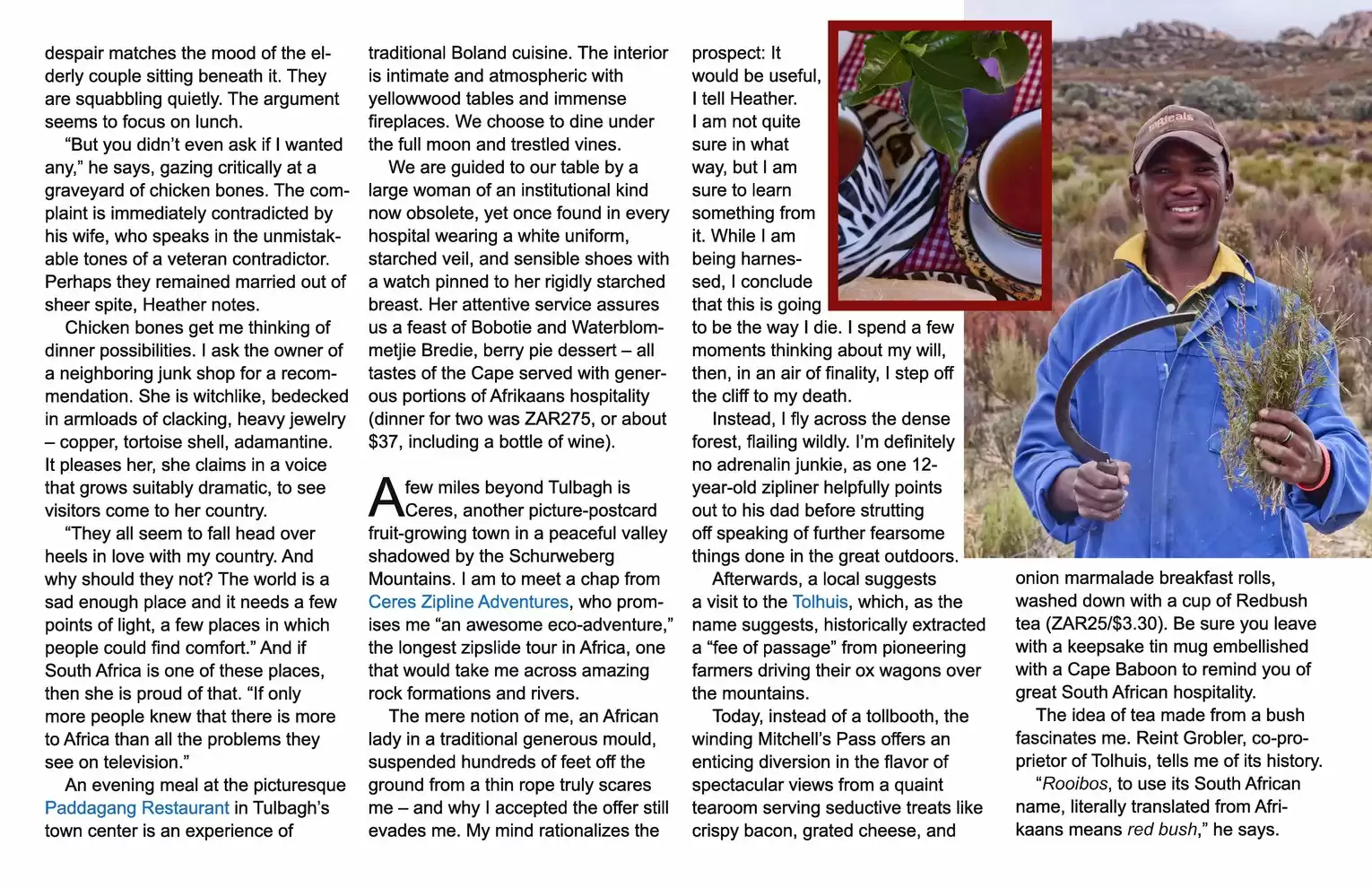
Afterwards, a local suggests a visit to the Tolhuis, which, as the name suggests, historically extracted a "fee of passage" from pioneering farmers driving their ox wagons over the mountains. Today, instead of a tollbooth, the winding Mitchell's Pass offers an enticing diversion in the flavor of spectacular views from a quaint tearoom serving seductive treats like crispy bacon, grated cheese, and onion marmalade breakfast rolls, washed down with a cup of Redbush tea (ZAR25/$3.30). Be sure you leave with a keepsake tin mug embellished with a Cape Baboon to remind you of great South African hospitality.
The idea of tea made from a bush fascinates me. Reint Grobler, co-proprietor of Tolhuis, tells me of its history.
"Rooibos, to use its South African name, literally translated from Afrikaans means red bush," he says.
| Previous Page | Next Page |