
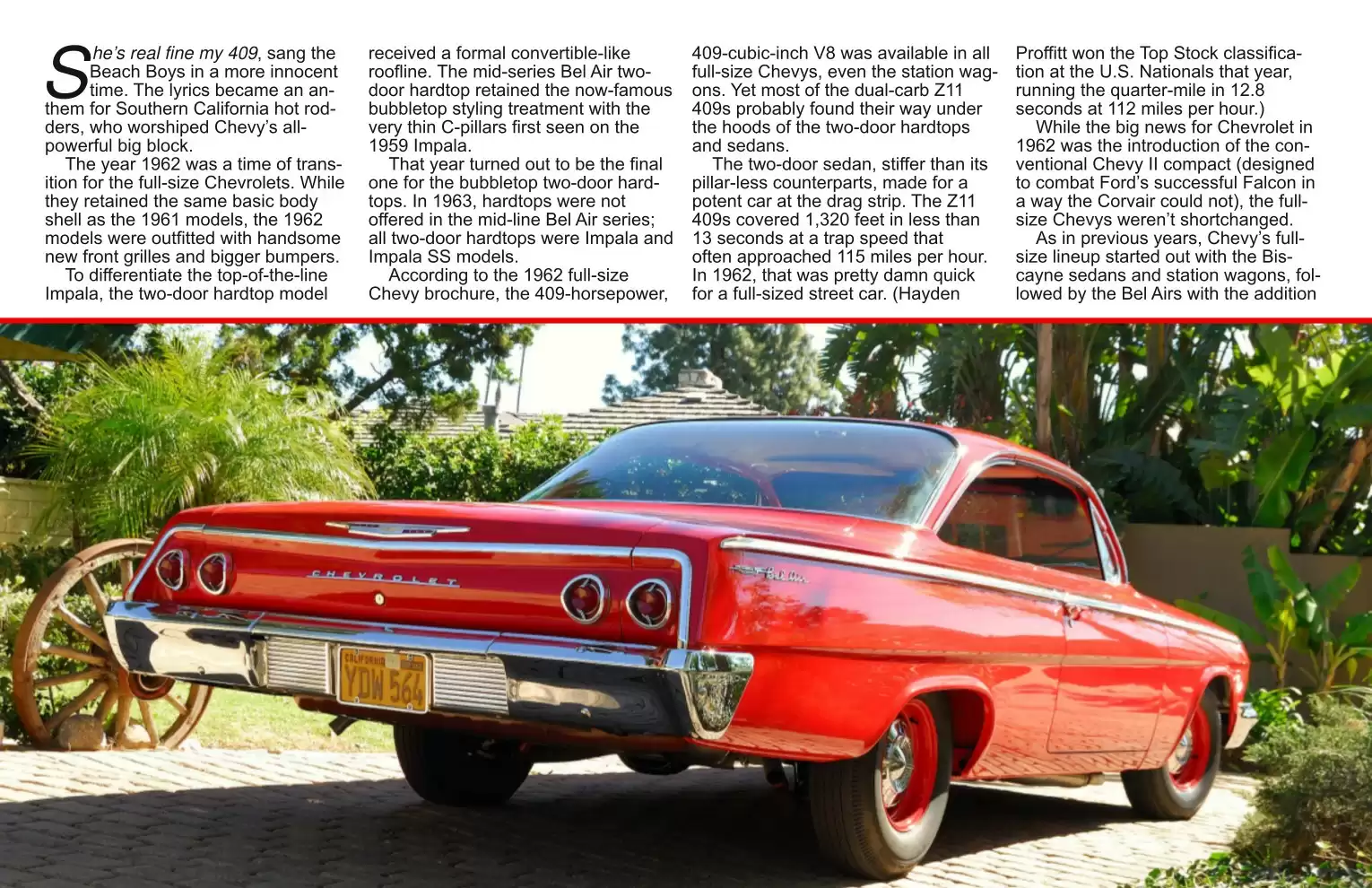
She's real fine my 409, sang the Beach Boys in a more innocent time. The lyrics became an anthem for Southern California hot rodders, who worshiped Chevy's all-powerful big block.
The year 1962 was a time of transition for the full-size Chevrolets. While they retained the same basic body shell as the 1961 models, the 1962 models were outfitted with handsome new front grilles and bigger bumpers.
To differentiate the top-of-the-line Impala, the two-door hardtop model received a formal convertible-like roofline. The mid-series Bel Air two-door hardtop retained the now-famous bubbletop styling treatment with the very thin C-pillars first seen on the 1959 Impala.
That year turned out to be the final one for the bubbletop two-door hardtops. In 1963, hardtops were not offered in the mid-line Bel Air series; all two-door hardtops were Impala and Impala SS models.
According to the 1962 full-size Chevy brochure, the 409-horsepower, 409-cubic-inch V8 was available in all full-size Chevys, even the station wagons. Yet most of the dual-carb Z11 409s probably found their way under the hoods of the two-door hardtops and sedans.
The two-door sedan, stiffer than its pillar-less counterparts, made for a potent car at the drag strip. The Z11 409s covered 1,320 feet in less than 13 seconds at a trap speed that often approached 115 miles per hour. In 1962, that was pretty damn quick for a full-sized street car. (Hayden Proffitt won the Top Stock classification at the U.S. Nationals that year, running the quarter-mile in 12.8 seconds at 112 miles per hour.)
While the big news for Chevrolet in 1962 was the introduction of the conventional Chevy II compact (designed to combat Ford's successful Falcon in a way the Corvair could not), the full-size Chevys weren't shortchanged.
As in previous years, Chevy's full-size lineup started out with the Biscayne sedans and station wagons, followed by the Bel Airs with the addition
| Previous Page | Next Page |
Contents
Features:
Columns & Opinion:
- Rear View Mirror (Richard Truesdell)
- The Road Ahead (Robyn Larson McCarthy)
- Opinion: Spirit of Ecstasy (Carmen Madrid)
- Opinion: Consumer Reports vs. My Lincoln/My Ford (Joseph Babiasz)