
Much depends on the price of oil, as always. If gas prices stay high or continue to rise, the Focus has a chance to do very well for Ford.
If fuel prices drop, the Focus could suffer, due to a sticker price that quickly balloons as options are added. A fully loaded Focus can flirt with $27,000, the same price-point as many well-equipped mid-size sedans. So buyers might face a tough choice.
That's not to say all Focuses (Focii?) are expensive. The price of entry is $16,995 (including the $725 delivery charge), same as the outgoing model. And the Chevrolet Cruze, which will be one of the Focus' biggest rivals, is priced similarly.
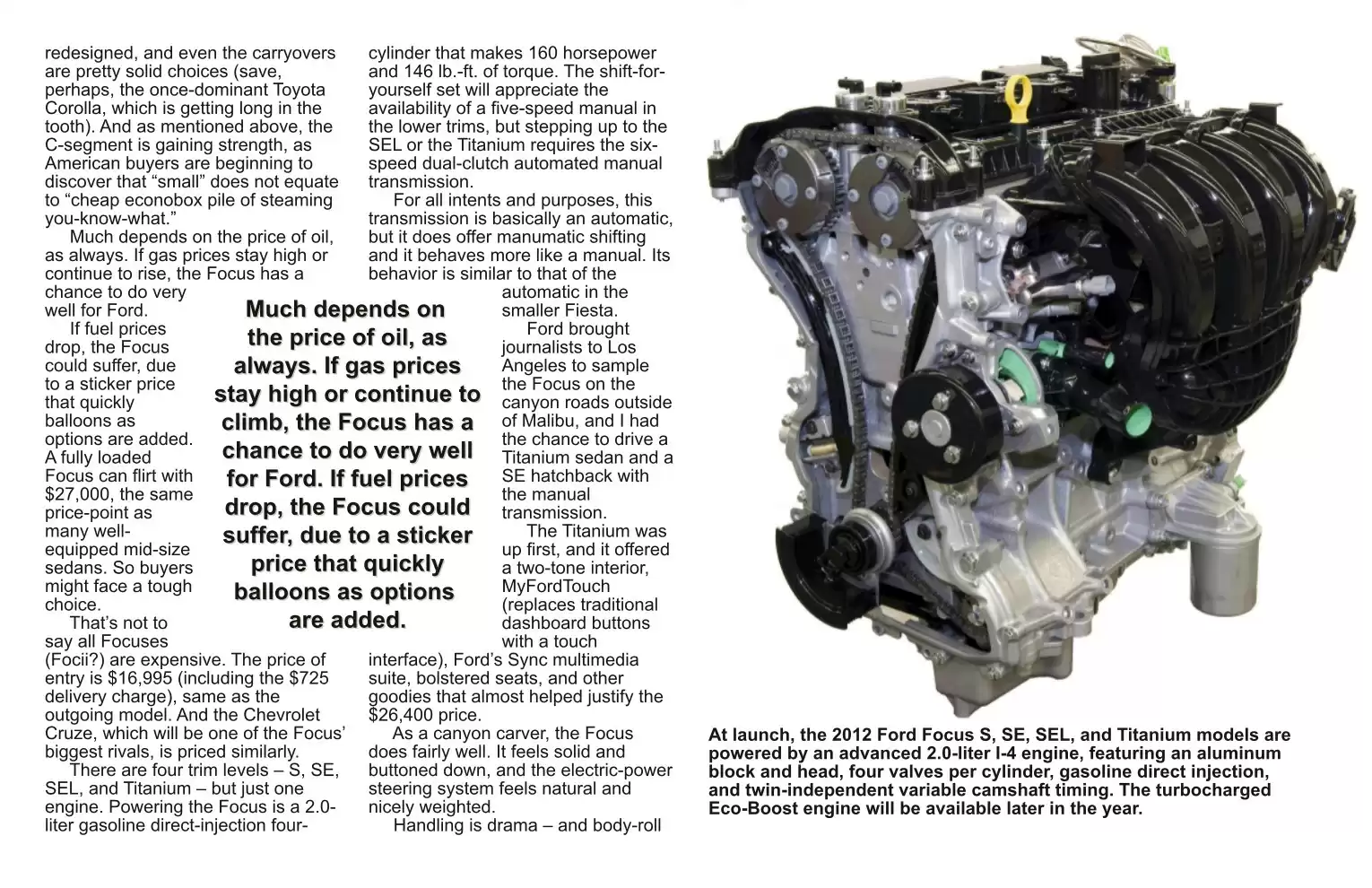
There are four trim levels--S, SE, SEL, and Titanium--but just one engine. Powering the Focus is a 2.0-liter gasoline direct-injection four-cylinder that makes 160 horsepower and 146 lb.-ft. of torque. The shift-for-yourself set will appreciate the availability of a five-speed manual in the lower trims, but stepping up to the SEL or the Titanium requires the six-speed dual-clutch automated manual transmission.
For all intents and purposes, this transmission is basically an automatic, but it does offer manumatic shifting and it behaves more like a manual. Its behavior is similar to that of the automatic in the smaller Fiesta.
Ford brought journalists to Los Angeles to sample the Focus on the canyon roads outside of Malibu, and I had the chance to drive a Titanium sedan and a SE hatchback with the manual transmission.
The Titanium was up first, and it offered a two-tone interior, MyFordTouch (replaces traditional dashboard buttons with a touch interface), Ford's Sync multimedia suite, bolstered seats, and other goodies that almost helped justify the $26,400 price.
As a canyon carver, the Focus does fairly well. It feels solid and buttoned down, and the electric-power steering system feels natural and nicely weighted.
Handling is drama--and body-roll
| Previous Page | Next Page |
Contents
Features:
Columns & Opinion:
- Rear View Mirror (Richard Truesdell)
- The Road Ahead (Robyn Larson McCarthy)
- Opinion: Spirit of Ecstasy (Carmen Madrid)
- Opinion: Consumer Reports vs. My Lincoln/My Ford (Joseph Babiasz)